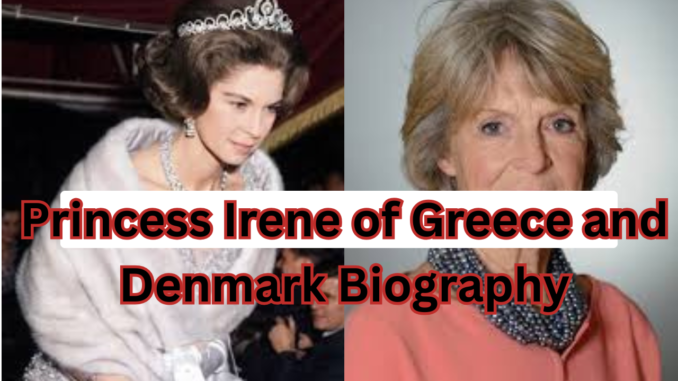
Biography
Princess Irene of Greece and Denmark was born on 11 May 1942 in Cape Town, South Africa, during one of the most turbulent periods in modern European history. Her birth did not take place in a royal palace in Athens, but in exile—because her parents had been forced to flee Greece during the German invasion in World War II.
She was the youngest child of King Paul of Greece and Queen Frederica of Hanover, and from the moment she was born, history had already shaped her destiny. Imagine beginning life not in certainty, but in displacement. That early experience of exile would quietly influence Irene’s worldview for decades to come.
After the war, her family moved through Egypt before finally returning to Greece in 1946. When her father became king in 1947, Irene grew up inside the royal household, but her upbringing was far from indulgent fantasy. It was disciplined, structured, and deeply conscious of duty.
Educated in Greece and later in Germany, Irene developed a sharp intellect and a deep love for culture. Unlike many royals of her generation, she was not content with ceremonial appearances alone. She gravitated toward music, philosophy, and inner exploration, as if searching for meaning beyond the palace walls.
For a brief but significant period in the 1960s, she pursued a professional career as a concert pianist, studying under the legendary Gina Bachauer. She performed internationally, including appearances in London and the United States. Music, for Irene, was not a hobby—it was a language through which she expressed her inner life.
Advertisements
Yet history intervened again. In 1967, her brother King Constantine II was overthrown following a military coup, forcing the royal family into exile once more. Irene’s life, once again, was uprooted. But rather than bitterness, she responded with reflection, study, and service.
Family
Princess Irene was born into the House of Glücksburg, one of Europe’s most influential royal dynasties. Her family connections stretched across the continent, linking Greece, Denmark, Spain, Germany, and beyond.
Her father, King Paul of Greece, ruled during a fragile post-war period and worked to stabilize a nation recovering from occupation and civil war. Her mother, Queen Frederica, was strong-willed, intellectual, and deeply influential in shaping Irene’s character.
Irene had two siblings who would go on to define modern European royal history. Her elder sister, Queen Sofía of Spain, became one of the most respected queens in modern Spanish history. Her brother, King Constantine II of Greece, was the last reigning monarch of Greece.
For a brief time, between her father’s death and the birth of her niece Princess Alexia, Irene was heiress presumptive to the Greek throne—a quiet historical footnote that reminds us how close she stood to the center of power, even though she never sought it.
Despite political upheavals and exile, Irene remained deeply loyal to her family. Her bond with Queen Sofía was especially close. When Irene later settled permanently in Spain, she lived at the Palace of Zarzuela, not as a political figure, but as a beloved sister and trusted companion.
Family, for Irene, was not about titles. It was about presence.
Personal Life
If there is one phrase that captures Princess Irene’s personal life, it is “independent spirit.” She never married and never showed regret about it. Instead, she filled her life with intellectual curiosity, humanitarian work, and personal passions.
She had a lifelong love for music, archaeology, and philosophy. After her exile from Greece, she lived for a time in India, where she studied Hindu philosophy at the University of Madras. There, she worked closely with respected philosopher T. M. P. Mahadevan, even helping him record his memoirs.
This was not the typical path of a European princess. While others navigated court politics, Irene explored spirituality, ethics, and the nature of consciousness. She was fascinated by subjects many would find unconventional—parapsychology, metaphysics, and even extraterrestrial life. To some, she seemed eccentric. To others, she was refreshingly authentic.
She dressed stylishly but disliked jewelry. She loved books more than banquets. After her father’s death, she became a vegetarian, reflecting her growing concern for compassion and non-violence.
Irene also co-authored archaeological essays with her sister Sofía and donated rare books and artifacts to museums. She translated philosophical texts and quietly supported intellectual work behind the scenes.
In 1986, she founded World in Harmony (Mundo en Armonía), a humanitarian organization she led for decades. Her charity work included animal welfare, education, and international relief efforts. When she received compensation from the European Court of Human Rights for confiscated royal property, she donated every cent to charity.
Age
Princess Irene lived a long and full life. She was 83 years old at the time of her death.
Born on 11 May 1942 and passing away on 15 January 2026, her life spanned eras of war, exile, dictatorship, democracy, and globalization. She witnessed the fall of monarchies, the rise of modern Europe, and dramatic shifts in royal relevance.
Cause of Death
Princess Irene of Greece and Denmark died on 15 January 2026 at the Palace of Zarzuela in Madrid, Spain, where she had lived for decades alongside her sister, Queen Sofía.
In her later years, Irene faced serious health challenges. She had successfully overcome breast cancer in 2002 after chemotherapy. In 2023, it was publicly revealed that she was suffering from cognitive impairment, which gradually worsened.
By mid-2025, her condition required her to withdraw from public life. Queen Sofía adjusted her entire schedule to remain by her side. In January 2026, the Spanish Royal Household announced that Irene’s health had deteriorated significantly. Two days later, she passed away peacefully.
Her death was due to natural causes related to age and illness.
She was buried at the Royal Cemetery at Tatoi Palace in Greece, alongside her parents and her brother, returning at last to the homeland that had shaped and exiled her.
Conclusion
Princess Irene of Greece and Denmark lived a life that defied expectations. Born into royalty but shaped by exile, she chose curiosity over convention, compassion over power, and reflection over spectacle.
She never ruled a country, but she ruled her own life with integrity. Like a pianist playing softly in a grand hall, her influence was subtle but deeply felt.
In a world obsessed with noise, Irene chose meaning. And that may be her greatest legacy.
FAQs
Who was Princess Irene of Greece and Denmark?
She was the youngest daughter of King Paul of Greece, sister to Queen Sofía of Spain, and a royal known for her intellectual, artistic, and humanitarian pursuits.
Did Princess Irene ever marry?
No, she never married and had no children. She lived an independent life focused on culture, philosophy, and charity.
Where did Princess Irene live later in life?
From 1981 until her death, she lived in Spain at the Palace of Zarzuela in Madrid.
What was Princess Irene known for besides royalty?
She was a trained concert pianist, a student of philosophy, a humanitarian, and the founder of World in Harmony.
How did Princess Irene of Greece and Denmark die?
She died peacefully from natural causes related to age and illness on 15 January 2026, at the age of 83.

Peter Charles is a journalist and writer who covers battery-material recycling, urban mining, and the growing use of microreactors in industry. With 10 years of experience in industrial reporting, he explains new technologies and industry changes in clear, simple terms. He holds both a BSc and an MSc in Electrical Engineering, which gives him the technical knowledge to report accurately and insightfully on these topics.
Leave a Reply