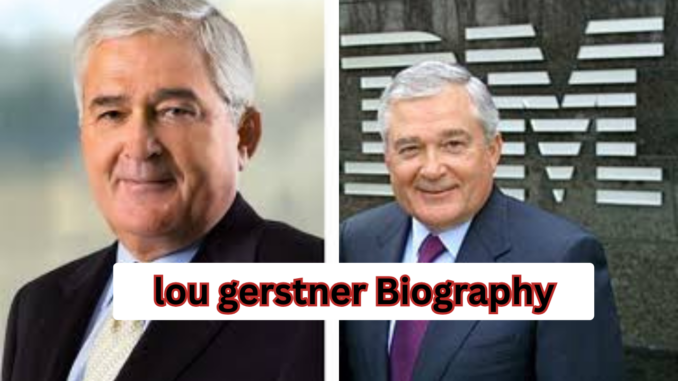
Biography
Louis Vincent Gerstner Jr., widely known as Lou Gerstner, was one of the most influential business leaders of the late 20th and early 21st centuries. He was born on March 1, 1942, in Mineola, New York, United States, into a middle-class American family that valued education, discipline, and hard work. From an early age, Gerstner showed strong leadership qualities, sharp intelligence, and an ability to think critically traits that would later define his remarkable career.
Lou Gerstner grew up during a period when America was experiencing rapid economic growth and technological change. These formative years helped shape his practical, results-driven mindset. Unlike many executives who rose through a single corporation, Gerstner built his reputation by succeeding across multiple industries, including consulting, financial services, consumer goods, and technology.
He became globally famous for leading one of the most dramatic corporate turnarounds in history saving IBM from near collapse in the 1990s. At a time when many experts believed IBM should be broken apart, Gerstner made the bold decision to keep the company together and refocus it on customer solutions rather than individual products. That choice alone cemented his place in business history.
Lou Gerstner passed away on December 27, 2025, at the age of 83, leaving behind a powerful legacy as a disciplined executive, strategic thinker, author, philanthropist, and mentor to generations of business leaders.
Education
Education played a central role in shaping Lou Gerstner’s worldview and leadership philosophy. He believed that learning should be practical, rigorous, and connected to real-world problems.
Advertisements
Gerstner attended Chaminade High School, a well-known Catholic school in New York, where he graduated in 1959. His time there instilled in him strong values of discipline, accountability, and service.
He later enrolled at Dartmouth College, where he earned a Bachelor of Arts (BA) degree in 1963. At Dartmouth, Gerstner developed his analytical thinking and leadership skills. The college environment encouraged debate, collaboration, and independent thinking qualities that would later define his management style.
After Dartmouth, Gerstner pursued an MBA at Harvard Business School, one of the most prestigious business schools in the world. At Harvard, he was trained in case-based learning, where students analyze real business problems and make tough decisions under uncertainty. This experience deeply influenced his belief that leadership is about execution, not theory.
Years later, Gerstner maintained strong ties to education, serving on boards and supporting institutions such as Harvard, MIT, and Memorial Sloan Kettering, proving that education was not just the beginning of his journey, but a lifelong commitment.
Career
Early Career and McKinsey & Company
Lou Gerstner began his professional career at McKinsey & Company, one of the world’s leading management consulting firms. At McKinsey, he learned how organizations function, how leaders make decisions, and how strategy can transform companies. Consulting exposed him to a wide range of industries and sharpened his ability to diagnose problems quickly.
American Express
In 1978, Gerstner joined American Express, marking a major turning point in his career. He eventually became Chairman and CEO of Travel Related Services, and later President of American Express.
At American Express, Gerstner was responsible for massive growth. He expanded the use of the American Express Card by targeting new customers such as college students, doctors, and women. He also introduced premium products like the Gold Card and Platinum Card, creating an image of exclusivity and prestige.
Under his leadership, membership grew from 8.6 million to over 30 million, and profits surged. The famous slogan “Membership Has Its Privileges” became one of the most successful marketing campaigns in business history.
RJR Nabisco
In 1989, Gerstner became Chairman and CEO of RJR Nabisco following its massive leveraged buyout. The company was struggling with debt, internal conflict, and public scrutiny. Gerstner focused on restoring discipline, improving operations, and stabilizing the business. His time at RJR further strengthened his reputation as a tough but effective leader.
IBM: The Historic Turnaround
Lou Gerstner’s most famous role came in April 1993, when he was hired as Chairman and CEO of IBM. At the time, IBM was on the brink of disaster, losing billions of dollars and facing intense competition.
Many experts believed IBM should be broken into smaller companies. Gerstner disagreed. He saw IBM’s true strength not in hardware, but in its ability to integrate technology solutions for customers.
He made several bold decisions:
- Kept IBM together as one company
- Shifted focus from products to services
- Emphasized execution over vision
- Reduced bureaucracy and internal politics
Under Gerstner’s leadership:
- IBM returned to profitability
- Market value grew from $29 billion to $168 billion
- IBM became a global leader in e-business and IT services
His leadership style was direct, no-nonsense, and results-driven. He famously said, “The last thing IBM needs right now is a vision.” Instead, he focused on fixing what was broken.
Gerstner retired as CEO in 2002, leaving IBM stronger, more competitive, and future-ready.
Later Career and Philanthropy
After IBM, Gerstner served as Chairman of The Carlyle Group from 2003 to 2008, guiding the firm through a period of growth. He also sat on boards of major corporations and nonprofits.
Through Gerstner Philanthropies, he donated hundreds of millions of dollars to education, biomedical research, environmental protection, and social welfare programs.
Personal Life
Lou Gerstner was known for keeping his personal life private. He was married to Robin Gerstner, and together they had two children. Despite his demanding career, Gerstner valued family and made time for personal reflection and balance.
He was not known as a flashy executive. Instead, he preferred substance over style, results over attention, and discipline over hype. Colleagues often described him as serious, focused, and deeply committed to doing the right thing.
Outside of business, Gerstner was passionate about education, public service, and healthcare research. His philanthropic efforts reflected a belief that success comes with responsibility.
Cause of Death
Lou Gerstner passed away on December 27, 2025, at the age of 83. While detailed medical information was not widely disclosed, his death was confirmed as being due to natural causes related to age.
His passing marked the end of an era in corporate leadership. Business leaders, educators, and policymakers around the world paid tribute to his legacy, especially his role in saving IBM and reshaping modern corporate management.
Conclusion
Lou Gerstner’s life story is a powerful lesson in leadership, courage, and execution. He proved that turning around a failing giant is not about flashy ideas, but about understanding people, customers, and systems. From American Express to IBM, Gerstner consistently delivered results where others failed.
His legacy lives on not only in the companies he transformed, but also in the institutions he supported and the leaders he inspired. Lou Gerstner will always be remembered as the man who taught the world that even elephants can dance.
FAQs
Who was Lou Gerstner?
Lou Gerstner was an American businessman best known for serving as CEO of IBM and leading its historic turnaround in the 1990s.
What was Lou Gerstner famous for?
He was famous for saving IBM from collapse and transforming it into a services-focused technology company.
What was Lou Gerstner’s education?
He earned a BA from Dartmouth College and an MBA from Harvard Business School.
When did Lou Gerstner die?
Lou Gerstner died on December 27, 2025, at the age of 83.
Did Lou Gerstner write any books?
Yes, he wrote Who Says Elephants Can’t Dance?, which details IBM’s transformation under his leadership.

Peter Charles is a journalist and writer who covers battery-material recycling, urban mining, and the growing use of microreactors in industry. With 10 years of experience in industrial reporting, he explains new technologies and industry changes in clear, simple terms. He holds both a BSc and an MSc in Electrical Engineering, which gives him the technical knowledge to report accurately and insightfully on these topics.
Leave a Reply