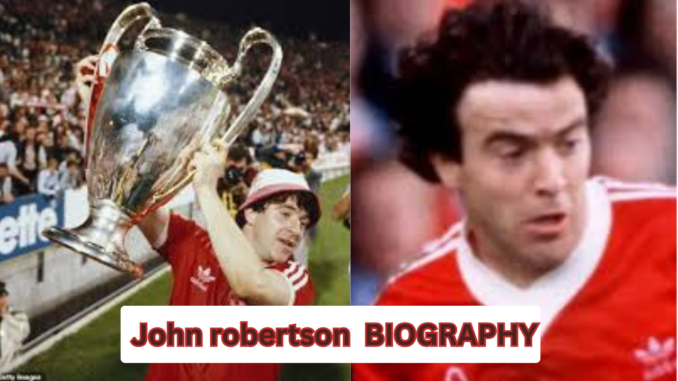
Biography
John Neilson Robertson was born on January 20, 1953, in Viewpark, Lanarkshire, Scotland. Growing up in a working-class Scottish environment, football wasn’t just a game it was a language, a dream, and a possible way out. Like many boys of his generation, John kicked a ball around long before he ever imagined lifting European trophies.
As a young player, Robertson represented Scotland at schoolboy and youth levels, showing early signs of intelligence and creativity on the ball. He also played for Drumchapel Amateurs, a famous breeding ground for Scottish talent. That’s where his journey took a serious turn.
In May 1970, at just 17 years old, John Robertson signed for Nottingham Forest. At the time, no one not even Robertson himself could have predicted the role he would eventually play in one of football’s greatest underdog stories.
His early years at Forest were quiet. He wasn’t an instant star. In fact, before legendary manager Brian Clough arrived, Robertson was close to being written off. He didn’t look like an athlete. He didn’t dominate physically. But Clough saw something others missed—a football brain, soft feet, and an ability to deliver the perfect ball at the perfect moment.
That belief changed everything.
Advertisements
Career
Nottingham Forest: From Doubt to Immortality
John Robertson’s career is inseparable from Nottingham Forest’s golden era. Under Brian Clough, Robertson transformed from a struggling midfielder into one of the most devastating left wingers in European football.
From 1976 to 1980, Robertson played 243 consecutive matches a testament to his consistency and importance. He wasn’t about speed or tricks. Instead, he used timing, balance, and vision like a chess grandmaster planning three moves ahead.
And then came the moments that made history.
- 1979 European Cup Final: Robertson delivered the perfect cross for Trevor Francis, who scored the only goal. That assist won Nottingham Forest their first European Cup.
- 1980 European Cup Final: One year later, Robertson went a step further—this time scoring the winning goal himself against Hamburg.
Think about that for a second. In back-to-back European Cup finals, he either created or scored the decisive goal. That’s not luck. That’s legacy.
During his time at Forest, Robertson helped the club win:
- First Division title
- Two League Cups
- European Cup (twice)
- UEFA Super Cup
- FA Charity Shield
- Anglo-Scottish Cup
Brian Clough once described him as “the Picasso of our game.” Not because he was pretty—but because he created beauty from simplicity.
Later Playing Years
In 1983, Robertson moved to Derby County. The transfer strained relationships behind the scenes and, sadly, injuries limited his impact. He never quite rediscovered his Forest form.
He returned briefly to Nottingham Forest in 1985, but the magic had faded. His playing career ended after short spells with Corby Town, Stamford, and Grantham Town.
International Career
John Robertson earned 28 caps for Scotland, scoring 8 goals. One of his most memorable moments came in 1981, when he scored the winning goal against England—a dream for any Scottish player.
He also represented Scotland at the 1982 FIFA World Cup, scoring against New Zealand. Even on the international stage, Robertson delivered when it mattered.
Coaching Career
After hanging up his boots, Robertson moved into coaching. He became a trusted assistant to Martin O’Neill, another former Forest teammate.
Together, they worked at:
- Wycombe Wanderers
- Norwich City
- Leicester City
- Celtic
- Aston Villa
Behind the scenes, Robertson played a key role in training, tactics, and player development. He wasn’t loud—but his football intelligence spoke volumes.
Personal Life
Away from football, John Robertson lived a relatively private life. Fame never seemed to interest him. Family did.
One of the most emotional chapters of his life involved his daughter Jessica, who was born in 1983 with cerebral palsy. She was quadriplegic and unable to speak, with doctors predicting a very short life expectancy.
John and his then-wife Sally devoted themselves to caring for her. In 1994, they pursued legal action against the hospital, believing medical negligence caused her condition. The case was heartbreaking and ultimately unsuccessful but it showed Robertson’s determination as a father.
He later spoke openly about how this experience changed his perspective on life, football, and success. Trophies fade. Family doesn’t.
Robertson also had another daughter, who appeared on the BBC quiz show “TNL: Who Dares Wins” in 2007—one of the few glimpses the public got into his family life.
In 2012, he released his autobiography, Supertramp, offering fans a rare, honest look into his career, struggles, and triumphs.
Family
John Robertson came from a humble Scottish background and remained deeply connected to his roots throughout his life.
Although football defined his public identity, his family defined his private one. His role as a father—especially in caring for a child with complex needs was something those close to him say he carried with quiet strength.
Despite supporting Rangers as a boy, Robertson famously described his years at Celtic as a coach as “the best years of his life in football.” That ability to separate loyalty from love of the game showed his maturity and professionalism.
To many former teammates, he was not just a legend—but a gentle, thoughtful presence in the dressing room.
Cause of Death
John Robertson passed away on December 25, 2025, at the age of 72.
While no dramatic public details surrounded his death, it came after years of health concerns. In 2013, Robertson suffered a suspected heart attack while playing tennis with a former teammate. Though he recovered, it was a reminder that even football legends are human.
His death on Christmas Day felt symbolic—quiet, reflective, and deeply emotional for fans across Scotland and England.
Tributes poured in from:
- Nottingham Forest supporters
- Former teammates and managers
- Scottish football fans
- Clubs he served as a player and coach
He wasn’t just remembered for goals and assists—but for intelligence, humility, and heart.
Conclusion
John Robertson’s story proves that greatness doesn’t always shout. Sometimes, it whispers. He didn’t look like a superstar, didn’t act like one, and never chased fame. Yet, when history needed a hero, he delivered—again and again.
From European Cup finals to quiet coaching roles, from personal heartbreak to professional triumph, Robertson lived a life rich in meaning. He wasn’t just a footballer. He was an artist, a fighter, and above all, a human being.
And that’s why his legacy will never fade.
FAQs
Who was John Robertson?
John Robertson was a Scottish professional footballer best known for his legendary career at Nottingham Forest and his role in winning two European Cups.
What position did John Robertson play?
He played primarily as a left winger, known for his intelligence, crossing ability, and composure.
How many European Cups did John Robertson win?
He won two European Cups with Nottingham Forest in 1979 and 1980.
What caused John Robertson’s death?
John Robertson passed away on December 25, 2025, following long-term health issues, including a suspected heart attack in earlier years.
Did John Robertson write an autobiography?
Yes, he released his autobiography titled Supertramp in 2012, sharing insights into his football career and personal life.

Peter Charles is a journalist and writer who covers battery-material recycling, urban mining, and the growing use of microreactors in industry. With 10 years of experience in industrial reporting, he explains new technologies and industry changes in clear, simple terms. He holds both a BSc and an MSc in Electrical Engineering, which gives him the technical knowledge to report accurately and insightfully on these topics.
Leave a Reply