Author: Peter

  • Shebeshxt Biography: The Full Story of His Life, Music Career, Personal Life, and Legal Issues

    Shebeshxt Biography: The Full Story of His Life, Music Career, Personal Life, and Legal Issues

    Shebeshxt is one of the most talked-about music artists to emerge from Limpopo, South Africa, in recent years. Loved by fans for his raw energy and unique sound, and criticized by others for his repeated controversies, Shebeshxt has built a name that cannot be ignored. His rise from a small town to national fame shows the power of social media, street credibility, and viral music culture. At the same time, his legal troubles have kept him constantly in the headlines.

    Biography

    Shebeshxt was born as Lehlogonolo Katlego Chauke in Lebowakgomo, Limpopo, South Africa. He was born and raised in this small town, which later became a strong influence on his music style, language, and personality. Growing up in Limpopo exposed him to local street culture, township life, and regional sounds that would later shape his identity as an artist.

    From an early age, Chauke showed interest in music and performance. Like many young people from underprivileged communities, music became both a form of expression and a possible escape from hardship. He adopted the stage name Shebeshxt, a name that later became controversial but also unforgettable in South African pop culture.

    Shebeshxt is also known by several other nicknames, including Bling Skats, MaBurner, Malome Shebe, and Shebeshesa. These names reflect different sides of his personality and how his fans see him. Over time, his bold behavior and fearless attitude made him stand out from many upcoming artists.

    Before fame, Shebeshxt lived a relatively quiet life in Lebowakgomo. However, once his music started gaining attention online, his life changed rapidly. His story represents a modern rise to fame driven by the internet rather than traditional music industry structures.

    Career

    Shebeshxt officially became active in the music industry in 2021, but his real breakthrough came when his song “Ke Di Shxt Malume” went viral on TikTok. The song spread quickly across social media platforms, especially among young people. Its raw lyrics, catchy rhythm, and unapologetic attitude made it popular almost overnight.

    The viral success attracted attention from established artists, including well-known rapper Focalistic, who reacted positively to the song. This public recognition helped Shebeshxt gain credibility and visibility within the South African music scene.

    Musically, Shebeshxt blends several genres, including Lekompo, Amapiano, and Rap. His sound is heavily influenced by local Limpopo rhythms and street-style delivery. He mainly performs using vocals and digital audio workstations (DAW), focusing on energy and crowd reaction rather than polished studio perfection.

    In 2022, he released his first project, “Topless Shxta’s Journey Vol 1”, followed by “Topless Shxta’s Journey Vol 2” in 2023. These projects helped solidify his fan base and showed his consistency as an independent artist. In 2024, he released “My Music My Story”, a title that reflected his desire to tell his own story without filters.

    One of the biggest moments in his career came in 2023 when he appeared on “Podcast and Chill with MacG.” The episode made history by reaching over one million views in just two days, without any record label backing, radio play, or television promotion. This achievement highlighted the power of his fan base and online influence.

    That same year, Shebeshxt signed a major partnership deal with Lamborghini Wines, an Italian company associated with the luxury Lamborghini brand. This deal was seen as a major achievement for an artist who had risen without traditional industry support.

    In 2025, Shebeshxt released the song “Rato Laka”, featuring Zee Nxumalo, Slidoo Man, and producer Naqua. The audio alone surpassed 3 million views on YouTube without a music video. When the video was later released, it gained over 2 million views in just one week. Following this success, he signed a distribution deal with Virgin Music Group, owned by Universal Music Group, marking a new level in his career.

    Personal Life

    Shebeshxt is known for keeping much of his personal life private, but his public behavior often gives fans insight into his personality. He is outspoken, emotional, and sometimes aggressive, which has contributed to both his popularity and his controversies.

    He has openly spoken about fear for his life, claiming at times that people were plotting to harm him. These statements increased public concern and showed the mental pressure that comes with fame, especially for artists with street backgrounds.

    Shebeshxt’s lifestyle reflects a mix of sudden fame and unresolved struggles. While he enjoys luxury, attention, and success, he also faces constant scrutiny. His personal choices often spill into public view, making it hard to separate his private life from his public image.

    Despite criticism, his supporters see him as a voice of the streets and a symbol of authenticity. To them, his flaws make him real rather than fake or manufactured.

    Legal Issue

    Shebeshxt’s career has been heavily affected by repeated legal problems. His first major legal trouble occurred in April 2023, when he was arrested and later appeared before the Lebowakgomo Magistrate’s Court on 9 May 2023. He faced charges including assault, attempted murder, and malicious damage to property.

    The case involved allegations that he discharged a firearm at a family home in Ga-Mamaola village, firing several shots into the air. His bail was denied, and he remained in custody for four months until his release in August 2023. Some firearm-related charges were later withdrawn in October 2023.

    In December 2023, Shebeshxt faced legal trouble outside South Africa when he was accused of breaching a performance contract in Botswana. This incident further damaged his reputation, although details remained limited.

    The most serious legal case came in October 2025, when he was allegedly involved in a shooting incident in Ladanna, Polokwane. He was accused of firing shots at another motorist’s vehicle, injuring a 34-year-old man. On 13 November 2025, he appeared before the Polokwane Magistrate’s Court and was charged with two counts of attempted murder.

    In a separate ongoing case, he also faces charges of assault with intent to cause grievous bodily harm, robbery with aggravating circumstances, malicious damage to property, and additional counts of attempted murder. His court appearances are scheduled to continue into 2026, making his legal situation uncertain.

    Conclusion

    Shebeshxt’s life is a powerful mix of talent, controversy, success, and struggle. From a small town in Limpopo to viral fame and international business deals, his rise shows how modern music careers can be built outside traditional systems. However, his repeated legal issues continue to threaten his freedom and long-term success.

    Whether he will be remembered mainly for his music or his controversies depends on how his story unfolds in the coming years. What is certain is that Shebeshxt remains one of the most talked-about and polarizing figures in South African music today.

    Frequently Asked Questions (FAQs)

    1. Who is Shebeshxt in real life?
    Shebeshxt’s real name is Lehlogonolo Katlego Chauke. He is a South African rapper from Lebowakgomo, Limpopo.

    2. What made Shebeshxt famous?
    He became famous after his song “Ke Di Shxt Malume” went viral on TikTok, gaining massive attention online.

    3. What music genre does Shebeshxt perform?
    Shebeshxt blends Lekompo, Amapiano, and Rap, with strong street and local influences.

    4. Has Shebeshxt signed a record deal?
    Yes, in 2025 he signed a distribution deal with Virgin Music Group, which is owned by Universal Music Group.

    5. Why is Shebeshxt always in the news?
    He is frequently in the news due to a mix of viral music success, public behavior, and ongoing legal cases related to serious criminal charges.

    See more…

  • Shin Min-ah Biography: Age, Career, Personal Life, Net Worth, and Philanthropy

    Shin Min-ah Biography: Age, Career, Personal Life, Net Worth, and Philanthropy

    Shin Min-ah is one of South Korea’s most loved actresses and models. Known for her natural beauty, warm screen presence, and versatile acting skills, she has built a career that spans more than two decades. From modeling as a teenager to becoming a top Korean drama and film star, Shin Min-ah’s journey is a story of steady growth, discipline, and quiet influence—both on screen and through her generous charity work.

    Biography of Shin Min-ah

    Shin Min-ah was born Yang Min-a on 5 April 1984 in Yecheon County, North Gyeongsang Province, South Korea. She grew up in a normal Korean household and spent her early years away from the entertainment spotlight. Her family name is Yang, but she later adopted Shin Min-ah as her stage name to avoid confusion with another actress.

    She attended Dongguk University, one of South Korea’s respected institutions, where many well-known actors have studied. Although she entered the entertainment industry very young, she remained focused on learning and self-improvement.

    Shin Min-ah first stepped into the public eye in 1998, when she was still a teenager. A friend secretly applied for her to join a modeling contest for the youth magazine KiKi. She won, and this unexpected moment marked the beginning of her professional career. Her fresh image, tall figure, and calm charm quickly made her stand out.

    Over the years, Shin Min-ah evolved from a teenage model into a respected actress admired across Asia. Today, she is recognized not only for her acting success but also for her kindness, humility, and long-term commitment to social causes.

    Career Journey: From Model to Top Actress

    Shin Min-ah’s career can be clearly divided into modeling success and acting excellence, both of which she has mastered with time and effort.

    Early Modeling Career

    Shin Min-ah began her career as a fashion and commercial model in 1998. She quickly became famous through advertisements for major brands such as Samsung and Korea Telecom. One of her commercial lines became extremely popular among young people, making her a recognizable face across the country.

    She was soon labeled one of the “four teenage commercial stars” of her generation. Her clean image and friendly smile made her one of the most in-demand commercial models in South Korea, a position she still holds today. She later worked with international fashion brands and appeared in global magazines, including Elle Korea and The New York Times T Magazine.

    Over time, Shin Min-ah became a brand ambassador for luxury fashion houses. She is currently associated with Gucci and Roger Vivier, representing Korean elegance on the global stage.

    Transition into Acting

    Shin Min-ah began acting through music videos, gaining attention for her emotional expressions. Her official acting debut came in the early 2000s. She trained seriously, taking acting lessons for months to avoid being seen only as a “model-turned-actress.”

    Her early roles showed promise, but it was her lead performances that truly shaped her career. She gained strong recognition with dramas and films such as A Love to Kill, My Girlfriend Is a Gumiho, and Arang and the Magistrate. These roles helped her build an image of a charming yet emotionally deep actress.

    Major Breakthrough and Career Peak

    Shin Min-ah’s career reached a new level with the romantic comedy My Girlfriend Is a Gumiho (2010). The drama became a huge hit and is still remembered as one of the most iconic fantasy romance series in Korean television.

    Later projects such as Oh My Venus (2015) showed her dedication to acting. For the role, she went through long makeup sessions and physical transformations, earning multiple acting awards. She continued to challenge herself with different genres, including political drama (Chief of Staff), mystery (Diva), and emotional slice-of-life stories (Our Blues).

    Her global popularity grew even more with Hometown Cha-Cha-Cha (2021), which became a major hit on Netflix worldwide. The drama introduced her to international audiences and confirmed her status as a top Korean actress.

    Personal Life and Relationships

    Shin Min-ah is known for being very private about her personal life. She avoids unnecessary media attention and focuses on her work and close relationships.

    In 2015, her relationship with fellow actor Kim Woo-bin was confirmed. The couple met while working as models for the same fashion brand. Over the years, they became one of South Korea’s most respected celebrity couples, admired for their loyalty and support for each other.

    After many years together, the couple officially married in December 2025 at the Shilla Hotel in Seoul. Their relationship is often praised for its maturity, stability, and mutual respect.

    Outside of acting, Shin Min-ah enjoys reading, traveling, and quiet daily routines. She has also written a travel book titled “Shin Min-ah’s French Diary,” sharing personal reflections from her trips.

    Net Worth and Earnings

    Shin Min-ah’s exact net worth is not publicly disclosed, but industry estimates place her net worth between $10 million and $15 million.

    Her income comes from multiple sources, including:

    • Television dramas
    • Film roles
    • High-value commercial endorsements
    • Luxury brand partnerships
    • Fashion campaigns

    She is considered one of the highest-paid actresses and endorsers in South Korea, especially known for maintaining long-term brand relationships rather than short-term promotions.

    Despite her wealth, Shin Min-ah is known for living modestly and directing a large portion of her earnings toward charitable causes.

    Philanthropy and Charity Work

    Shin Min-ah is widely respected for her consistent and quiet philanthropy. Unlike many celebrities, she does not seek attention for her donations.

    Since around 2008, she has donated regularly to organizations such as:

    • Community Chest of Korea (Fruit of Love)
    • Asan Medical Center
    • Good Friends, supporting North Korean defectors
    • Hallym Burn Foundation
    • Seoul National University Children’s Hospital

    By 2025, her total donations exceeded ₩4 billion, making her one of South Korea’s most generous celebrity donors. She donates monthly, supports disaster relief efforts, helps children with medical needs, and contributes to education and elderly care.

    She has also donated during major crises, including:

    • COVID-19 pandemic relief
    • Earthquake relief (Nepal, Turkey–Syria)
    • Wildfire and flood disaster support in Korea

    Her charity work has earned her national recognition, including a Presidential Citation and the Good People Artist Award.

    Conclusion

    Shin Min-ah’s life is a powerful example of balance—success without arrogance, fame without excess, and wealth with responsibility. From a teenage model to a global Korean drama star, she has built a career based on patience, talent, and integrity. Beyond acting, her long-term commitment to philanthropy shows a deep sense of humanity. Shin Min-ah is not only a star on screen but also a role model in real life.

    Frequently Asked Questions (FAQs)

    1. How old is Shin Min-ah?
    Shin Min-ah was born on 5 April 1984 and is currently 41 years old.

    2. Who is Shin Min-ah married to?
    She is married to South Korean actor Kim Woo-bin. They wed in December 2025.

    3. What is Shin Min-ah best known for?
    She is best known for dramas like My Girlfriend Is a Gumiho, Oh My Venus, Hometown Cha-Cha-Cha, and Our Blues.

    4. What is Shin Min-ah’s net worth?
    Her estimated net worth is between $10 million and $15 million, mainly from acting and endorsements.

    5. Is Shin Min-ah involved in charity work?
    Yes. She has donated over ₩4 billion to medical care, disaster relief, children’s welfare, and social support programs.

    See more…

  • Sunitha Krishnan Biography: Life, Career, Personal Story, Net Worth, and Age

    Sunitha Krishnan Biography: Life, Career, Personal Story, Net Worth, and Age

    Sunitha Krishnan is one of India’s most respected social activists. She is known for her fearless fight against sex trafficking and her lifelong commitment to protecting women and children. As the co-founder of Prajwala, one of the world’s largest anti-human trafficking organizations, her work has changed thousands of lives. This detailed biography explains her background, career journey, personal life, age, and net worth.

    Biography of Sunitha Krishnan

    Sunitha Krishnan was born in 1972 in Bangalore, India. She comes from a Palakkad Malayali family. Her father, Raju Krishnan, worked with the Department of Survey of India, and her mother is Nalini Krishnan. Because of her father’s job, Sunitha traveled across many parts of India during her childhood. This early exposure helped her understand the struggles of people from different regions and backgrounds.

    From a very young age, Sunitha showed a deep concern for others. At just eight years old, she began teaching dance to mentally challenged children. By the age of twelve, she was already running small schools in slum areas to educate underprivileged children. Her passion for social work was clear even before her teenage years.

    A tragic incident at the age of fifteen changed her life forever. While working on a neo-literacy campaign for the Dalit community, Sunitha was gang raped by eight men. The attackers opposed her presence in what they described as a “man’s society.” She was brutally beaten and suffered permanent damage, becoming partially deaf in one ear. Instead of breaking her spirit, this horrific experience became the driving force behind her lifelong mission to fight sexual violence and exploitation.

    Sunitha studied in Central Government Schools in Bangalore and Bhutan. She later earned a Bachelor’s degree in Environmental Sciences from St. Joseph’s College, Bangalore. Determined to work directly with vulnerable communities, she completed her Master of Social Work (Medical and Psychiatric) at Roshni Nilaya School of Social Work, Mangalore.

    Career and Social Activism

    Sunitha Krishnan’s professional journey is deeply rooted in social justice and human rights. After completing her studies, she moved to Hyderabad to work with Poverty Intervention Network (PIN) as a coordinator for young women’s programs. During this time, she became actively involved in housing rights and led protests when slum dwellers near the Musi River faced eviction.

    In 1996, Sunitha met Brother Jose Vetticatil, Director of Boys’ Town, Hyderabad. This meeting proved to be life-changing. That same year, sex workers from Mehboob ki Mehandi, a red-light area in Hyderabad, were evicted, leaving thousands of women homeless and vulnerable. Sunitha and Brother Jose decided to act.

    Together, they founded Prajwala, an organization dedicated to fighting sex trafficking. They started a transition school in a vacated brothel to protect children of sex workers from being trafficked. In the early years, Sunitha faced extreme financial hardship. She sold her jewelry and even household utensils to keep the organization running.

    Today, Prajwala operates on five strong pillars: prevention, rescue, rehabilitation, reintegration, and advocacy. The organization provides legal, medical, psychological, and social support to survivors while also working to bring traffickers to justice. Prajwala has rescued and rehabilitated over 28,600 survivors, making it the largest anti-trafficking shelter in the world.

    Sunitha also leads economic rehabilitation programs, training survivors in skills such as carpentry, welding, printing, masonry, and housekeeping. These skills help survivors rebuild their lives with dignity and independence.

    She has worked closely with police departments, Women Protection Cells, and Anti-Human Trafficking Units. Her efforts have helped secure the conviction of more than 150 traffickers. She also started the first Crisis Counseling Centre inside a police station in Afzalgunj, Hyderabad, creating a model for Police–NGO collaboration.

    Beyond grassroots work, Sunitha has played a major role in shaping public policy. She drafted rehabilitation policies for trafficking victims in Andhra Pradesh and contributed to India’s 2013 anti-rape law. She also led major awareness campaigns, including “Men Against Demand”, with the powerful slogan “Real Men Don’t Buy Sex,” which reached over 1.8 billion people worldwide.

    Her advocacy extends globally. She has spoken at TED India, universities in the United States, corporate conferences, and international forums, inspiring millions to take action against trafficking.

    Personal Life

    Despite her demanding work, Sunitha Krishnan has built a supportive personal life. She is married to Rajesh Touchriver, an Indian filmmaker, scriptwriter, and art director. Rajesh has collaborated with Prajwala on several impactful films focused on social issues.

    One of their most notable films, “Anamika – The Nameless,” became part of the curriculum at the National Police Academy. Another film, “Naa Bangaaru Talli,” won three National Film Awards in 2014 and several international honors. Through films and documentaries, Sunitha uses storytelling as a tool to expose the realities of sex trafficking.

    Sunitha lives a life of simplicity and purpose. She runs Prajwala as a full-time volunteer and does not draw a salary from the organization. She supports herself through writing books and delivering lectures and seminars around the world.

    Her work has not been without danger. She has been physically attacked 14 times, faced acid attacks, poisoning attempts, and constant death threats. Yet, she remains firm in her mission, stating that these threats have only strengthened her resolve.

    Age and Net Worth

    As of 2025, Sunitha Krishnan is 52–53 years old, having been born in 1972.

    When it comes to net worth, Sunitha Krishnan does not live a wealthy lifestyle. There is no publicly confirmed figure for her net worth. This is mainly because she dedicates her life to social service rather than personal financial gain. She does not earn from Prajwala and chooses to live modestly. Any income she earns comes from book royalties, public speaking, and seminars, most of which supports her personal needs and advocacy work.

    Her true wealth lies in the lives she has saved, the survivors she has empowered, and the global awareness she has created around human trafficking.

    Conclusion

    Sunitha Krishnan’s life is a powerful story of courage, resilience, and purpose. From surviving a brutal assault as a teenager to becoming one of India’s strongest voices against sex trafficking, her journey is deeply inspiring. Through Prajwala, she has rescued tens of thousands of victims and influenced laws, policies, and public attitudes. Her work reminds the world that one person’s determination can create lasting change. Sunitha Krishnan is not just a social activist; she is a symbol of hope, justice, and human dignity.

    Frequently Asked Questions (FAQs)

    1. Who is Sunitha Krishnan?
    Sunitha Krishnan is an Indian social activist and the co-founder of Prajwala, an NGO that rescues and rehabilitates victims of sex trafficking.

    2. What is Sunitha Krishnan famous for?
    She is famous for her work against human trafficking and for founding Prajwala, one of the largest anti-trafficking organizations in the world.

    3. How old is Sunitha Krishnan?
    Sunitha Krishnan was born in 1972 and is currently 52–53 years old.

    4. Is Sunitha Krishnan married?
    Yes, she is married to Rajesh Touchriver, an Indian filmmaker and scriptwriter.

    5. What awards has Sunitha Krishnan received?
    She has received many awards, including the Padma Shri (2016), Ashoka Fellowship, CNN-IBN Real Hero Award, and several international human rights honors.

    See More…

  • Anthony Joshua Biography: Net Worth, Age, Career, and Personal Life

    Anthony Joshua Biography: Net Worth, Age, Career, and Personal Life

    Anthony Joshua Biography

    Anthony Joshua is one of the most famous boxers of the modern era. Known for his power, discipline, and calm personality, he has become a global sports icon and a role model to millions of young people around the world. From humble beginnings in London to becoming a multiple-time heavyweight world champion, Anthony Joshua’s story is one of hard work, focus, and resilience.

    Anthony Joshua’s Early Life, Age, and Background

    Anthony Oluwafemi Olaseni Joshua was born on October 15, 1989, in Watford, Hertfordshire, England. As of now, Anthony Joshua is 35 years old. His parents are of Nigerian Yoruba descent, and this heritage has played an important role in shaping his identity and values.

    Anthony spent part of his childhood in Nigeria, where he attended school for a short period before returning to the United Kingdom. Growing up, he was tall and athletic, but he did not immediately focus on boxing. Like many young people, he explored different interests while finding his path in life.

    As a teenager, Anthony Joshua was more interested in football and athletics. He showed strong physical ability, especially in sprinting and strength-based sports. However, his life changed when he was introduced to boxing at the age of 18. What started as a way to stay fit quickly turned into a passion and then a professional career.

    Despite facing challenges while growing up, Anthony Joshua remained focused on self-improvement. His early life experiences helped him develop mental strength, discipline, and respect—qualities that later became key to his success in boxing.

    Anthony Joshua’s Boxing Career and Major Achievements

    Anthony Joshua’s boxing career is one of the most impressive success stories in modern heavyweight boxing. He began boxing seriously in 2007, and within a few years, he was already making headlines.

    Amateur Career and Olympic Gold

    Anthony Joshua rose quickly in amateur boxing. His biggest amateur achievement came in 2012, when he represented Great Britain at the London Olympic Games. Against all odds, Joshua won the gold medal in the super-heavyweight division, defeating top boxers from around the world. This victory made him a national hero in the UK and marked the beginning of his rise to global fame.

    Professional Career Breakthrough

    After the Olympics, Anthony Joshua turned professional in 2013. He signed with Matchroom Boxing and was promoted by Eddie Hearn. From the start, Joshua showed incredible power, knocking out most of his opponents in the early rounds.

    In 2016, he won his first world title by defeating Charles Martin to claim the IBF heavyweight championship. Later that same year, he beat Wladimir Klitschko in an unforgettable fight at Wembley Stadium, adding the WBA (Super) title to his collection.

    World Titles and Comebacks

    Over the years, Anthony Joshua has held multiple heavyweight titles, including:

    • IBF Heavyweight Title
    • WBA (Super) Heavyweight Title
    • WBO Heavyweight Title

    He faced one of the biggest shocks of his career in 2019, when he lost to Andy Ruiz Jr.. However, Joshua showed great determination by winning the rematch later that year and reclaiming his titles.

    Although he later lost his belts to Oleksandr Usyk, Anthony Joshua remains one of the most respected and competitive heavyweights in boxing. His career is marked by courage, discipline, and a willingness to face the best fighters in the world.

    Anthony Joshua’s Net Worth, Endorsements, and Lifestyle

    Anthony Joshua is not only successful in the boxing ring but also extremely successful financially. His hard work has made him one of the richest boxers in the world.

    Anthony Joshua’s Net Worth

    Anthony Joshua’s estimated net worth is between $80 million and $100 million. This wealth comes from:

    • Fight purses
    • Pay-per-view earnings
    • Brand endorsements
    • Sponsorship deals

    Some of his biggest fights have earned him tens of millions of dollars in a single night.

    Endorsements and Business Deals

    Anthony Joshua has endorsement deals with major global brands such as:

    • Under Armour
    • Beats by Dre
    • Jaguar Land Rover
    • Hugo Boss

    These deals have helped him build a strong brand outside boxing. He is known for his clean image, professionalism, and business mindset.

    Lifestyle and Assets

    Despite his wealth, Anthony Joshua is known for living a relatively disciplined and private life. He owns luxury homes, high-end cars, and enjoys traveling, but he often emphasizes the importance of focus and training over flashy living.

    He has also invested in businesses and properties, showing that he is thinking about long-term financial stability beyond boxing.

    Anthony Joshua’s Personal Life, Family, and Relationships

    Anthony Joshua keeps his personal life mostly private, which has helped him avoid unnecessary controversy.

    Family and Cultural Roots

    Joshua is proud of his Nigerian heritage and often speaks about his cultural background with respect. He maintains a close relationship with his family, especially his mother, who has been a strong influence in his life.

    Relationships and Children

    Anthony Joshua is not married, but he is a father to a son, whom he loves deeply. He has often said that becoming a father changed his outlook on life and made him more responsible.

    When it comes to romantic relationships, Joshua prefers to keep things away from public attention. He believes privacy helps him stay focused on his career and personal growth.

    Personality and Values

    Anthony Joshua is known for being calm, respectful, and disciplined. Outside boxing, he enjoys reading, learning, and spending time with close friends and family. He also supports charitable causes, especially those focused on youth development and sports.

    Anthony Joshua’s Legacy, Influence, and Future Plans

    Anthony Joshua’s impact on boxing goes beyond titles and money. He has inspired a new generation of boxers, especially young people from diverse backgrounds.

    Influence on Boxing

    Joshua helped bring heavyweight boxing back into the mainstream, especially in the UK. His fights regularly fill stadiums and attract millions of viewers worldwide. He showed that boxing success can come with professionalism, education, and positive values.

    Challenges and Growth

    Every great athlete faces setbacks, and Anthony Joshua is no exception. His losses have shown his human side and his willingness to learn and improve. Many fans respect him even more for how he handles defeat with dignity.

    Future Goals

    Anthony Joshua has made it clear that he still wants to compete at the highest level. His goals include:

    • Winning another world heavyweight title
    • Taking part in historic fights
    • Building a strong legacy beyond boxing

    No matter what the future holds, Anthony Joshua has already secured his place as one of the most important figures in modern boxing history.

    Conclusion

    Anthony Joshua’s life story is a powerful example of what focus, discipline, and determination can achieve. From a young man discovering boxing late to becoming a global heavyweight champion, his journey continues to inspire millions. With a successful career, strong personal values, and a lasting influence on the sport, Anthony Joshua remains a true icon of boxing and modern sports culture.

    Frequently Asked Questions (FAQs)

    1. What is Anthony Joshua’s current net worth?
    Anthony Joshua’s net worth is estimated to be between $80 million and $100 million, earned from boxing fights and endorsement deals.

    2. How old is Anthony Joshua now?
    Anthony Joshua was born on October 15, 1989, making him 35 years old.

    3. Is Anthony Joshua married?
    No, Anthony Joshua is not married, but he has a son and values his role as a father.

    4. What titles has Anthony Joshua won in boxing?
    He has held the IBF, WBA (Super), and WBO heavyweight titles during his professional career.

    5. What is Anthony Joshua’s nationality and background?
    Anthony Joshua is British by nationality and of Nigerian Yoruba descent, which he proudly embraces.

    See More…


  • Mary Ann Maslog Biography: The Full Story of Her Life, Scandals, and Legal Troubles

    Mary Ann Maslog Biography: The Full Story of Her Life, Scandals, and Legal Troubles

    Mary Ann Maslog is one of the most controversial figures in modern Philippine history. Her name has been linked to major government scams, identity changes, international fraud, and dramatic court cases spanning more than two decades. From being a medical representative to becoming a convicted criminal, her story is complex, shocking, and filled with twists that continue to attract public attention.

    This extensive and well-researched biography explains who Mary Ann Maslog is, how she rose to prominence, the controversies that defined her life, and the truth behind her alleged death. Written in simple English, this article aims to be informative, engaging, and helpful for readers searching for accurate details about her life.

    Biography

    Mary Ann Maslog is a Filipina businesswoman who became widely known due to her involvement in the 1998 Department of Education, Culture and Sports (DECS) textbook scam. Over the years, she has used several names, including Mary Ann Evans Smith, Mary Ann Tupa Maslog, Mary Ann Tupa Maslog–Smith, and Jessica Sese Francisco. These name changes later became central to her legal and identity-related controversies.

    She was born in the Philippines and began her professional life in the early 1990s. In 1992, Mary Ann worked as a medical representative for Dispo Philippines in Davao City. Her career progressed quickly, and within the same year, she was promoted to Assistant Sales Manager. She was later assigned to Butuan City, where she met her future husband, Rommel Maslog.

    In 1997, Mary Ann and Rommel established Esteem Enterprises, a company focused on securing government contracts for the supply of medicines and textbooks. This business later became the center of one of the biggest textbook-related scandals in Philippine history.

    Despite attempts to disappear from public view, fake her death, and assume new identities, Mary Ann Maslog resurfaced multiple times, leading to renewed investigations and eventual imprisonment.

    Career

    Mary Ann Maslog’s career began legitimately in the private sector. Her early work in pharmaceutical sales showed promise, and her rise within Dispo Philippines demonstrated her ability to negotiate and manage sales operations.

    Her career took a major turn when she entered the world of government procurement. Through Esteem Enterprises, she actively pursued contracts with government agencies, particularly the DECS. This ambition led directly to the infamous 1998 DECS textbook scam.

    1998 DECS Textbook Scam

    In late 1998, Mary Ann Maslog conspired with DECS officials Emilia V. Aranas and Ernesto R. Guiang. Investigations revealed that the two officials processed and approved a ₱24 million supply contract in favor of Esteem Enterprises. The documents supporting the release of funds, including the Sub-Allotment Release Order (SARO), were later found to be falsified.

    On January 19, 1999, Maslog was caught delivering ₱3 million in cash inside a box at the Department of Budget and Management office within the Malacañang Palace compound. The box was addressed to then DBM Secretary Benjamin Diokno, who immediately ordered an investigation by the National Bureau of Investigation (NBI) and the Philippine National Police (PNP).

    Senate Hearings and “Gang of Four” Allegations

    Mary Ann was summoned to Senate hearings led by Senator Nene Pimentel. During the hearings, she was described as evasive. The NBI disclosed that the money was allegedly intended for senior officials, although these claims were later dismissed.

    Senator Raul Roco revealed that Maslog was allegedly part of the so-called “Gang of Four”, a group of lobbyists accused of influence-peddling at DECS. Maslog denied being part of this group, but the allegations severely damaged her public image.

    United States Immigration Scam

    After fleeing the Philippines, Maslog moved to the United States and assumed the name Mary Ann Smith. She remarried and became involved in an immigration fraud scheme through a company called International Business Network (IBN).

    The scheme targeted immigrants seeking student visas for relatives. Victims were charged $6,500 per applicant, and the operation falsely claimed connections with U.S. immigration authorities. At least 34 victims lost a total of $359,270. Maslog pleaded guilty to wire fraud and mail fraud and was sentenced to six years in prison in the United States.

    Personal Life

    Mary Ann Maslog was previously married to Rommel Maslog, who later became the mayor of Talisayan, Misamis Oriental. Their marriage eventually ended in separation.

    During her time in the United States, she remarried Michael Lee Smith, adopting his surname. Reports later suggested that she had a relationship with a foreign national named Wouter De Jong.

    Her personal life has often overlapped with her professional and criminal activities. She maintained close connections with politicians, law enforcement officers, and influential figures, which later raised serious ethical and legal questions.

    Controversies

    Mary Ann Maslog’s life is marked by numerous controversies that span decades.

    Fake Death Claim

    In 2019, her lawyers submitted documents to the Sandiganbayan claiming that she had died on November 18, 2019. Based on these death certificates, the case against her was temporarily dismissed. This move shocked the public when she reappeared years later.

    Return as “Jessica Francisco”

    Maslog later returned to the Philippines under the identity “Dr. Jessica Sese Francisco.” She claimed to be a consultant and business supplier, but authorities failed to verify her credentials.

    In September 2024, she was arrested after complaints of fraud related to water systems and medical supplies in Bangsamoro. Fingerprint analysis confirmed that Jessica Francisco and Mary Ann Maslog were the same person.

    Involvement in Alice Guo Case

    Maslog became involved in the investigation surrounding the escape and arrest of former Bamban Mayor Alice Guo. She admitted traveling to Indonesia to meet Guo and claimed involvement with the PNP Intelligence Group, though officials denied her statements.

    Her inconsistent testimonies led to calls for contempt proceedings in the Senate.

    Cause of Death

    Despite official claims made in 2019, Mary Ann Maslog is not dead.

    The alleged cause of death presented to the Sandiganbayan was later proven false. Her supposed death was based on fraudulent documents, which allowed her to temporarily avoid conviction. Her reappearance in 2024 exposed the deception.

    As of January 2025, Maslog is alive, convicted of graft, and serving a 10-year prison sentence at the National Bureau of Investigation facility in Muntinlupa.

    Conclusion

    Mary Ann Maslog’s biography is a powerful example of how deception, ambition, and misuse of influence can lead to long-term consequences. From a promising professional career to becoming a symbol of corruption and fraud, her story reflects serious weaknesses in systems of accountability.

    Her multiple identities, fake death claim, and repeated involvement in high-profile cases have made her one of the most talked-about figures in Philippine legal history. Today, her conviction serves as a reminder that justice, even if delayed, can still prevail.

    Frequently Asked Questions (FAQs)

    1. Who is Mary Ann Maslog?
    Mary Ann Maslog is a Filipina businesswoman known for her role in the 1998 DECS textbook scam and later fraud cases in the Philippines and the United States.

    2. Is Mary Ann Maslog dead?
    No. Claims of her death in 2019 were false. She was later arrested and convicted.

    3. What crime did Mary Ann Maslog commit?
    She was convicted of graft related to the DECS textbook scam and also served prison time in the U.S. for immigration fraud.

    4. Why did Mary Ann Maslog use different names?
    She used multiple identities to evade authorities and continue her activities under new aliases.

    5. Where is Mary Ann Maslog now?
    As of 2025, she is imprisoned at the National Bureau of Investigation facility in Muntinlupa.

    See More…

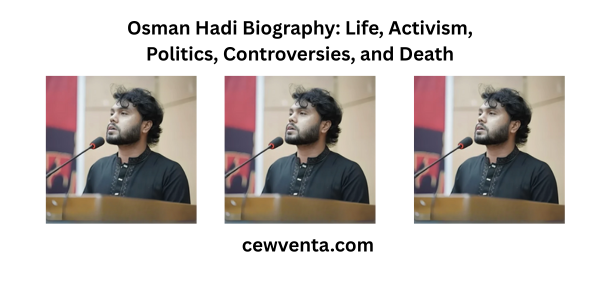
  • Osman Hadi Biography: Life, Activism, Politics, Controversies, and Death

    Osman Hadi Biography: Life, Activism, Politics, Controversies, and Death

    Biography

    Sharif Osman Bin Hadi, widely known as Osman Hadi, was born on 30 June 1993 in Nalchity Upazila, Jhalokathi District, Bangladesh. He grew up in a religious Muslim household, shaped strongly by faith, discipline, and community values. His father was a madrasa teacher and a local imam, and this background deeply influenced Osman Hadi’s moral outlook, public speaking style, and sense of responsibility toward society. He was the youngest among six siblings and was raised in an environment where education, ethics, and social justice were highly valued.

    From an early age, Osman Hadi showed strong interest in public affairs, debate, and social issues. Growing up in rural Bangladesh, he witnessed poverty, political inequality, and the effects of power imbalance on ordinary citizens. These early experiences planted the seeds of his later activism. His upbringing combined religious education with awareness of national identity, which later shaped his political positions, especially his views on sovereignty and foreign influence.

    He completed his secondary and higher secondary education at Jhalakati N.S. Kamil Madrasa, where he passed the Alim examination, an Islamic equivalent of higher secondary education. His academic strength and interest in politics led him to enroll at the University of Dhaka, where he studied Political Science during the 2010–2011 academic session. The University of Dhaka, long known as the heart of political thought and activism in Bangladesh, played a major role in shaping his political ideology and leadership skills.

    Osman Hadi later became a well-known youth activist and political organizer. He rose to national attention after the July Revolution, where his outspoken criticism of state repression, political corruption, and foreign dominance resonated with many young people. Until his death on 18 December 2025, Osman Hadi remained one of the most visible and controversial young political figures in Bangladesh.

    Career

    Osman Hadi’s career was a unique mix of education, activism, and politics. Before entering full-time political organizing, he worked as an English language coach at Saifur’s Coaching Center, one of the most popular private education institutions in Bangladesh. This role helped him develop strong communication skills and confidence in public speaking, which later became central to his activism.

    He later joined the University of Scholars, a private university in Dhaka, as a lecturer. Teaching allowed him to engage with young minds and sharpen his political and social arguments. His time as an educator strengthened his belief that political awareness and civic responsibility must begin with youth education.

    Osman Hadi became nationally prominent during the July Revolution, a period of mass protests and youth-led movements demanding accountability for killings, repression, and corruption. At the time, he lived in Rampura, Dhaka, where he served as a local coordinator, organizing protests, meetings, and political discussions. His ability to mobilize young people and articulate strong political messages brought him into the national spotlight.

    He was one of the founders and leaders of Inqilab Moncho, a political platform born from the July uprising. Inqilab Moncho presented itself as a movement-based organization rather than a traditional political party. Its goals included defending Bangladesh’s independence, opposing all forms of domination, and building what Osman Hadi described as an “Insaaf-based state”, meaning a state rooted in justice and fairness.

    Osman Hadi was especially vocal about banning the Awami League from politics, accusing the party of repression, corruption, and responsibility for protest-related deaths. At public gatherings, including a large “martyrs’ assembly” in Shahbagh, he urged opposition parties to include the trial and banning of the Awami League in their election promises. He also announced plans for mass marches and long-term protests if demands were not met.

    In May 2025, he called for the formation of a National Government that would include all anti–Awami League forces, such as the Bangladesh Nationalist Party, Jamaat-e-Islami, and other opposition groups. He believed that unity among opposition forces was necessary to prevent what he called the return of authoritarian politics.

    Ahead of the 2026 general election, Osman Hadi announced his intention to contest as an independent candidate for the Dhaka-8 constituency. He organized consultation meetings, conducted a “van rally,” and promised to expose corruption if elected. His campaign language was aggressive, direct, and appealing to frustrated young voters who felt ignored by traditional politicians.

    Personal Life

    Despite his public presence, Osman Hadi kept his personal life largely private. He did not frequently speak about his family in public, choosing instead to focus on political issues and national debates. However, it was known that he remained close to his family and deeply respected his parents, especially his father’s role as a religious teacher.

    Osman Hadi lived a modest lifestyle. Friends and supporters often described him as disciplined, focused, and deeply committed to his beliefs. He spent most of his time organizing meetings, writing, speaking, or engaging with supporters both online and offline. Social media played a major role in his activism, as he used it to share statements, criticize political developments, and mobilize supporters.

    He was also an author. In February 2024, he published a Bengali book titled “লাভায় লালশাক পূবের আকাশ” (The Eastern Sky Turned Red Amaranth by Lava). The book reflected his revolutionary ideas, emotional intensity, and vision of political change. Writing was another way through which he expressed his frustration, hope, and political philosophy.

    Controversies

    Osman Hadi was no stranger to controversy. His sharp language, uncompromising positions, and frequent criticism of both ruling and opposition parties made him a polarizing figure. He openly accused several opposition groups of trying to monopolize the July uprising and claimed that some youth leaders had become corrupt after gaining influence.

    One major controversy occurred during the National Citizen Party’s March to Gopalganj, where clashes broke out. In a moment of anger, Osman Hadi used profanity and made comments calling for the dissolution of Gopalganj District. The statement caused widespread outrage and debate across the country. Critics accused him of irresponsibility and inflammatory rhetoric.

    Later, Osman Hadi responded to the backlash by calling his statement an “epic of liberation”, though he also expressed regret to those who felt offended. This incident highlighted both his emotional political style and the risks of extreme rhetoric in a tense political environment.

    He also faced criticism for his strong anti-Indian stance, which some viewed as necessary nationalism and others saw as dangerous escalation. Despite criticism, Osman Hadi refused to soften his positions, insisting that fear and compromise were the reasons past movements had failed.

    Cause of Death

    On 12 December 2025, Osman Hadi was shot in the head at approximately 2:25 p.m. in the Paltan area of Dhaka, shortly after leaving a mosque following Jumma prayers. According to police reports, the attack was carried out by assailants on a motorcycle. The shooter was identified as Faisal Karim Masud, with Alamgir Sheikh allegedly driving the motorcycle. Another individual, Rubel, was accused of surveilling Hadi before the attack.

    Osman Hadi was rushed to Dhaka Medical College Hospital, where he was found to be in a deep coma with a Glasgow Coma Scale score of 3, indicating critical brain injury. He was later transferred to Evercare Hospital Dhaka, and on 15 December, the government airlifted him to Singapore General Hospital for advanced treatment.

    Despite all medical efforts, Osman Hadi died on 18 December 2025 at around 9:30 p.m. from complications related to his gunshot injuries.

    His death triggered widespread unrest across Bangladesh, especially in Dhaka. Protests turned violent, media offices were attacked, and strong anti-Indian sentiment surfaced. The government announced a BDT 5 million reward for information related to the attackers. His killing became one of the most politically significant assassinations in recent Bangladeshi history.

    Conclusion

    Osman Hadi’s life was short but deeply impactful. From a madrasa-educated youth in Jhalokathi to a national political figure, his journey reflected the anger, hope, and restlessness of a generation seeking change. He challenged powerful institutions, inspired young activists, and paid the ultimate price for his political stance. Whether remembered as a revolutionary hero or a controversial agitator, Osman Hadi’s legacy will continue to shape political conversations in Bangladesh for years to come.

    Frequently Asked Questions (FAQs)

    Who was Osman Hadi?
    Osman Hadi was a Bangladeshi politician, activist, and founder of Inqilab Moncho, known for his role in the July Revolution and youth-led movements.

    What was Osman Hadi known for?
    He was known for opposing Indian influence, demanding justice for July martyrs, and calling for a ban on the Awami League.

    How did Osman Hadi die?
    He died on 18 December 2025 from gunshot injuries after being attacked in Dhaka on 12 December.

    Was Osman Hadi involved in elections?
    Yes, he announced his candidacy as an independent candidate for the Dhaka-8 constituency ahead of the 2026 general election.

    Why was Osman Hadi controversial?
    His strong language, radical demands, criticism of political parties, and anti-Indian rhetoric made him a highly controversial figure.

    See More…

  • Maria Catalina Cabral Biography: Age, Husband, DPWH, Family, Career, Personal Life, Controversies And Cause Of Death

    Maria Catalina Cabral Biography: Age, Husband, DPWH, Family, Career, Personal Life, Controversies And Cause Of Death

    Maria Catalina Cabral Biography

    Maria Catalina Cabral was born on May 23, 1962, in Manila, Philippines. Maria Catalina E. Cabral was a long-serving civil engineer and public servant in the Philippines. She rose through the ranks of the Department of Public Works and Highways (DPWH) over many years and eventually served as Undersecretary for Planning and Public-Private Partnership. Cabral was widely known in government and infrastructure circles for her technical background, long service, and leadership roles. Maria Catalina Cabral was 63 years old as of 2025.

    Cabral trained as a civil engineer and later earned advanced academic qualifications, including doctoral degrees in business and public administration. Official profiles and public resumes show she also pursued further studies and short programs at well-known institutions and took courses in areas such as data analytics and digital transformation. Her combination of engineering and management education shaped a career that moved between technical project work and high-level planning inside the DPWH and related public agencies.

    Throughout her career she built a reputation for expertise in road engineering, flood mitigation design, and project planning. She also broke gender barriers in a male-dominated field: Cabral was reported to be the first rank-and-file female staff member of the DPWH to rise to the level of undersecretary, and she served in leadership roles in professional engineering organizations. Colleagues often described her public profile as that of a seasoned bureaucrat who combined technical skill with administrative experience.

    Maria Catalina Cabral Career

    Cabral’s professional life centered on infrastructure planning, project programming, and public-private partnership work. She began at the DPWH in an entry role and steadily rose through positions that covered field engineering, planning, and procurement. Over time she took on management posts that required both engineering judgment and budgetary planning, which prepared her to guide national infrastructure programs.

    In November 2014 she was appointed Undersecretary for Planning and PPP at the DPWH. In that post her office handled national infrastructure programming, budget consolidations, and the preparation of priority projects. The role connected technical design with the exercise of budget choices, making it central to how the DPWH proposed and prioritized projects in the National Expenditure Program and national infrastructure plans. Her tenure included public speaking, representation on boards such as the National Irrigation Administration, and active participation in technical and policy forums.

    Cabral also served in professional bodies including the Philippine Institute of Civil Engineers and the Road Engineering Association of the Philippines. She won numerous awards and national recognitions for public service and engineering excellence, and she held teaching or professional chair positions in academic settings. Those honors reflected a career that combined technical depth with a public-facing leadership role.

    Her responsibilities sometimes placed her at the center of politically sensitive decisions. The DPWH planning office she led was responsible for drafting lists of proposed projects that could later be included in the government budget process. Because such lists can determine which local projects receive funding, the office became a focal point in national debates about transparency, budget insertions, and how priority projects are set. Cabral’s role therefore combined technical planning with high political visibility.

    Maria Catalina Cabral Personal Life

    Cabral kept much of her private life out of public view. Public profiles and official resumes focused on her professional qualifications rather than personal details. News reports indicate Maria Catalina Cabral was married to Thomas Cabral and had family who survived her, but she rarely discussed private matters in public. Her life was primarily presented to the public as the life of a technical leader and bureaucrat.

    Peers who worked with her described her as disciplined, technically minded, and focused on detail. They noted she combined engineering training with management skills and a commitment to building professional capacity among engineers. Outside work she participated in industry events and in professional organizations, and she earned respect for being a woman who rose through technical ranks to senior leadership. Her quiet profile meant that colleagues and the institutions she served were often the best sources of information about her character and work.

    Maria Catalina Cabral Controversies

    In 2025 Cabral became a prominent figure in national inquiries about alleged irregularities in flood control projects. Lawmakers and investigatory bodies examined claims that some projects were listed in budgets as “insertions” or “allocables” and that the project lists were influenced before budgets reached the legislature. The questions raised covered whether project lists were created or steered to benefit specific contractors or regions. Cabral was called to testify before congressional panels and was subpoenaed by independent investigatory bodies looking into the matter. She denied that she took part in kickback schemes and said her work was limited to planning rather than project execution.

    Her resignation from the DPWH in September 2025 came amid these probes and increasing scrutiny. Public officials accepted her resignation, and several investigatory panels continued to request documents and testimony from current and former DPWH staff — including material that Cabral was said to possess. Lawmakers publicly expressed concern that her departure and untimely death could hamper full disclosure of records relevant to the investigations. Several representatives urged authorities to secure her devices, emails, and project files as part of the probe.

    Because the allegations involved allocations worth many millions, the controversy touched political, technical, and legal questions. Some lawmakers said documents linked to Cabral could prove which people or groups benefited from particular budget insertions. Others warned against speculation and asked law enforcement and anti-graft bodies to follow proper legal steps, preserve evidence, and protect witnesses. The Independent Commission for Infrastructure and the Office of the Ombudsman were among the institutions that urged careful, timely preservation of records to support ongoing inquiries.

    Maria Catalina Cabral Death

    On December 18–19, 2025, authorities found Maria Catalina Cabral unconscious and unresponsive near the Bued River at Kennon Road in Benguet. Rescuers retrieved her from a ravine area and she was later pronounced dead in the early hours of December 19. Local police initially reported an alleged fall into the ravine and said the scene was being investigated. National media reported the discovery and law enforcement’s involvement as they began a formal inquiry.

    Because Cabral had been linked to high-profile investigations into flood control projects, her sudden death sparked immediate calls from lawmakers and independent bodies for a prompt and thorough probe. Some representatives publicly asked whether anyone might benefit from her death and urged authorities to treat her devices and papers as potential evidence. The Independent Commission for Infrastructure explicitly called for law enforcement to preserve her gadgets and files and to rule out foul play. Investigators from local police, the scene-of-crime operatives, and national agencies were reported to be coordinating in the early stages of the inquiry.

    At the time of reporting, authorities had not publicly concluded whether Cabral’s death was an accident, suicide, or the result of foul play. Multiple news outlets made clear the investigation was ongoing and that official findings would follow once forensic work, witness interviews, and a full accounting of physical and digital evidence were complete. Officials also asked the public to allow the investigative process to proceed and to respect the family’s privacy while inquiries continue.

    Conclusion

    Maria Catalina Cabral’s life was a long career in engineering and public service. She rose from technical roles to senior planning positions at the DPWH and earned recognition in professional circles for her leadership and expertise. In 2025 she became a figure in high-profile probes of infrastructure budgeting, a role that placed her under intense public scrutiny. Her sudden death near Kennon Road in December 2025 deepened public concern and led lawmakers and independent bodies to call for a careful, transparent investigation.

    FAQs

    Who was Maria Catalina Cabral and what was her role at the DPWH?

    Maria Catalina Cabral was a senior civil engineer and the former Undersecretary for Planning and Public-Private Partnership at the Department of Public Works and Highways. She led planning and programming work that fed into national infrastructure budgets.

    Why was Cabral under investigation in 2025?

    Cabral was asked to explain how project “insertions” or “allocables” were made in budget lists connected to flood control works. Lawmakers and investigatory bodies were probing alleged irregularities and possible links to contractors and allocations. She denied involvement in kickbacks and said her role focused on planning work.

    When and where did she die?

    Reports say Cabral was found unconscious near the Bued River below Kennon Road in Benguet on December 18, 2025, and was declared dead early on December 19. Local police reported an alleged fall and investigators opened a probe.

    Will investigators look at Cabral’s digital records and devices?

    Yes. The Independent Commission for Infrastructure and other agencies urged authorities to secure and preserve Cabral’s documents, phones and computers to assist ongoing investigations into flood control allocations and to determine what information she held. The Office of the Ombudsman and law enforcement were reported to be coordinating the evidence preservation effort.

    Where can I read official updates about the investigation?

    Follow major Philippine news outlets and official releases from the Benguet Provincial Police, the DPWH, the Office of the Ombudsman, and the Independent Commission for Infrastructure for verified updates. These organizations will publish official statements as the inquiry advances.

    See More

  • Oritsemeyiwa Eyesan Biography: Age, Husband, Education, Career, Personal Life And Nomination

    Oritsemeyiwa Eyesan Biography: Age, Husband, Education, Career, Personal Life And Nomination

    Oritsemeyiwa Eyesan Biography

    Oritsemeyiwa Eyesan was born on April 15, 1972, in Delta State, Nigeria. She trained first as an economist and later built a long career in the nation’s oil and gas sector. Her public profile emphasises more than three decades of steady professional growth inside the Nigerian National Petroleum Company and its subsidiaries. Oritsemeyiwa Eyesan is 53 years old as of 2025.

    Eyesan studied economics at the University of Benin, an institution known for producing graduates with both strong theory and useful practical skills. Her economics training helped her understand markets, project evaluation, and the financial side of large energy investments. Over time she combined that analytical grounding with hands-on experience in planning, procurement and strategic work inside NNPC. She is also listed as a member of professional bodies such as the Society of Petroleum Engineers and the Strategic Management Society, which shows her continued engagement with technical and strategic networks.

    From the start of her public career, Eyesan moved in roles that linked operations to strategy. That pattern prepared her to work on complex deals, to speak at international energy forums, and to lead teams that balanced commercial goals with environmental and policy concerns. Observers describe her as a practical strategist who focuses on getting projects across the finish line while keeping sustainability and investor confidence in view.

    Oritsemeyiwa Eyesan Career

    Oritsemeyiwa Eyesan’s career is a textbook example of steady advancement in a technical, commercial and policy-driven industry. She began in the early 1990s at NNPC subsidiaries, holding operational posts that gave her a ground-level view of how petroleum products are stored, moved and marketed. Those early roles included logistics, procurement and planning positions that built her understanding of the supply chain and commercial flows inside Nigeria’s energy value chain.

    As she rose through the ranks, Eyesan moved into planning, economics and corporate strategy. She served as deputy manager and later as a general manager in planning and decision-support functions at NAPIMS, the NNPC division that manages investments and joint ventures. Those jobs asked her to evaluate investment proposals, appraise field development plans, and advise on the economics of large upstream projects. Her work connected technical proposals to the hard numbers that matter to investors and government alike.

    A major career milestone came when she was named Chief Strategy and Sustainability Officer at NNPC Limited during the company’s commercial transformation. In that role, Eyesan led efforts to knit together corporate strategy and sustainability goals, helping the company adapt to the new commercial framework under the Petroleum Industry Act. She worked on frameworks to commercialise associated gas and helped drive negotiations and deals that unlocked major deepwater investments and new refining-related commercial arrangements. Her transition from strategy to executive field operations later showed that she has both the planning skills and the operational grasp needed at the top levels of the energy sector.

    In September 2023 she was appointed Executive Vice President for Upstream Operations at NNPC Limited. That position put her in charge of Nigeria’s exploration and production activities — the technical heart of the oil business. As EVP Upstream she focused on improving production, attracting investments, streamlining contracting, and managing joint-venture relationships with international oil companies. During her time at the helm of upstream operations, Eyesan pushed for faster approvals, clearer commercial terms, and technical standards that could make Nigerian projects more investible.

    Her career also includes work on notable national projects. She played an important role in negotiating agreements to renew deepwater PSCs and to commercialise associated gas (often shorted as “NAG” frameworks). The renewed agreements for assets such as OML 118 were reported to unlock multibillion-dollar investments into deepwater projects, moves that industry observers say improved investor confidence in Nigeria’s offshore sector. These achievements show how strategy and negotiation can convert stalled assets into active projects.

    Oritsemeyiwa Eyesan Personal Life

    Eyesan keeps her personal life deliberately private. Public profiles and official biographies emphasise professional credentials and accomplishments rather than family details. She lives in Abuja as befits a senior national executive, and she is identified in reports as a member of the Itsekiri community from Delta State. Colleagues describe her as disciplined, detail-oriented, and physically active — known to enjoy jogging, cycling and fitness routines that help her balance a demanding professional role. Her low-key personal profile has helped her protect family privacy while she pursues public and corporate responsibilities.

    Professionally she is known for building diverse teams and for operating on merit. Industry commentators often note her reputation as “detribalised” in the sense that she pursues competence and institutional process over ethnic or regional favoritism. That reputation matters in Nigeria’s complex governance environment because it signals a focus on rules, transparency and predictable processes — values that international investors look for in energy regulators and corporate leaders.

    Oritsemeyiwa Eyesan Nomination

    In December 2024 and into 2025, Eyesan’s rising profile culminated in high-level executive roles and, most recently, national nomination. President Bola Ahmed Tinubu nominated Oritsemeyiwa Amanorisewo Eyesan as Chief Executive Officer of the Nigerian Upstream Petroleum Regulatory Commission (NUPRC), a position that would make her the top regulator for upstream operations if confirmed by the Senate. The nomination came as part of a broader set of changes in the oil sector, following other leadership shifts at regulatory agencies. Reports covered the nomination as a signal that the administration seeks experienced, homegrown leadership to stabilise licensing rounds and to attract fresh upstream investment.

    Her nomination is grounded in long executive experience: Eyesan led strategic planning at NNPC and later ran upstream operations as an EVP, meaning she understands both the operator’s perspective and the regulatory challenges that the NUPRC must manage. Observers have argued that an individual with her mix of commercial and technical experience is well placed to accelerate licensing rounds, approve pending field development plans, and implement regulatory measures designed to boost production and attract capital. At the same time, her appointment places her in a politically sensitive role that requires balancing investor demands, environmental obligations, and national development needs.

    Industry responses to her nomination were broadly positive in many quarters. Several business and energy commentators praised her commercial judgement and her track record in negotiating large-scale deals and in shaping NNPC’s corporate strategy following the Petroleum Industry Act. Still, a lead regulator’s job is complex and highly visible: Eyesan will face immediate pressures to deliver faster approvals, to protect national resources, and to work with security and operations teams to limit theft and production losses. Her confirmation by the Senate will be watched closely by investors and by Nigerians who hope to see meaningful growth in oil and gas output.

    Conclusion

    Oritsemeyiwa Eyesan is a senior energy executive whose career maps directly onto Nigeria’s recent petroleum reforms. She climbed from operational roles in the NNPC group to strategic leadership as Chief Strategy & Sustainability Officer and to executive responsibility as EVP Upstream. Her nomination to head the NUPRC reflects the government’s interest in placing experienced, commercially-minded professionals at the centre of upstream regulation. As Nigeria seeks to unlock deepwater investment, to commercialise gas resources, and to increase production, Eyesan’s mix of economics training, strategic experience, and operational knowledge positions her as a key actor in the sector’s next phase.

    FAQs

    What is Oritsemeyiwa Eyesan’s educational background?

    Eyesan graduated in Economics from the University of Benin and later strengthened her professional credentials through industry networks and executive roles. Her public profiles list membership in professional bodies like the Society of Petroleum Engineers.

    What roles has Eyesan held at NNPC?

    She has served in planning, procurement and commercial roles, rose to be Group General Manager in Corporate Planning & Strategy, was Chief Strategy & Sustainability Officer, and was appointed Executive Vice President for Upstream Operations.

    What major projects did Eyesan help deliver?

    Her profile credits her with work to commercialise associated gas (NAG frameworks), with helping renew deepwater PSCs such as agreements around OML 118, and with contributing to strategic efforts that unlocked large offshore investments.

    Why is she nominated to lead the NUPRC?

    Her mix of operator experience, strategic planning record and commercial negotiation skills led the president to nominate her as a candidate to lead the upstream regulator at a time when Nigeria seeks to attract investment and raise production. The nomination was officially sent to the Senate for confirmation.

    See More

  • What Are The Limitations On Reaction Types And Throughput That Microreactors Cannot Overcome, Even With “Numbering-Up”

    What Are The Limitations On Reaction Types And Throughput That Microreactors Cannot Overcome, Even With “Numbering-Up”

    Microreactors are hyped for good reasons: they offer excellent heat transfer, fast mixing, and precise residence time control. But hype can hide limits. If you’re an engineer, manager, or investor deciding whether to replace a chunk of your plant with microreactor modules, you need to know not just what microreactors can do, but what they cannot do — even when you “number-up” (run many identical units in parallel). This article gives a practical, detailed, and balanced answer. I’ll explain fundamental physical bounds, chemistry types that resist micro-scale approaches, throughput and economic ceilings, and real-world operational blockers. Expect plain language, analogies, step-by-step thinking, and an honest decision framework you can use right away.

    Microreactors and “numbering-up” — the basic idea

    Microreactors are reactors with small flow channels (microns to millimetres) where reactants flow continuously. To scale production you can either make the channels bigger (scaling-up) or replicate units many times (numbering-up). Numbering-up preserves the micro-scale physics that give better control, but it multiplies practical issues: manifolds, pumps, sensors, maintenance points, and capital items. Numbering-up sounds elegant on slides — “just copy the module a hundred times” — but the devil is in the details. Some reaction classes and throughput levels reveal that copying is not always a practical cure.

    Fundamental limits rooted in physics — you can’t cheat conservation laws

    The first truth is simple: chemistry obeys physics. Heat, mass, and momentum conservation impose timescales and transport limits that no clever engineering can eliminate. Microreactors improve heat and mass transfer per unit volume, but they do not change activation energies, molecular diffusivities, or the need for certain physical residence times to reach equilibrium. If a reaction intrinsically requires hours or days for conversion or crystal aging, making channels smaller doesn’t make the chemistry faster — it just forces you to hold reagents in a flow loop for the same time or string many meters of channels together, which is impractical.

    Reactions with very long intrinsic timescales — the residency problem

    Some reactions, especially those controlled by slow kinetics like certain enzyme-catalysed processes, polymer chain growth to very high molecular weights, or slow solid-state transformations, simply need long residence times (hours to days). In theory you could create a very long microchannel or use massive numbers of parallel channels to get the same throughput, but in practice that becomes impossible: pressure drop skyrockets, the physical layout becomes unmanageable, and fouling or drift during long residence times becomes severe. Microreactors excel when residence times are seconds to minutes — beyond that, batch or stirred tank approaches are often better.

    Heterogeneous, slurry and solids-forming reactions — channel clogging is real

    Narrow channels and solids are a bad mix. If a reaction forms precipitates, polymerizes into high-molecular-weight solids, or uses slurries, those particles readily deposit and clog channels. Numbering-up means multiplying the number of vulnerable points. Techniques like segmented flow, periodic back-flush, filter traps, or inline crystallization can mitigate this, but they add complexity and often only push the problem downstream. Reactions that generate significant solids—bulk crystallizations, many inorganic precipitations, and late-stage polymer agglomeration—are therefore poor candidates for classic microreactor arrays.

    High-viscosity reactions and polymerizations — pumping and mixing fight back

    As viscosity rises, pumping energy and pressure drops climb steeply. Microchannels excel with low-to-moderate viscosity fluids where laminar flow still allows good mixing at the microscale. But many polymerizations and epoxy or resin formulations become viscous during the reaction. In microreactors, this causes dramatic increases in pressure and shear — and risks shear-induced degradation of target polymers. You can use larger meso-scale channels or hybrid approaches, but then you lose some microreactor benefits. Numbering-up also multiplies pump complexity: each module needs robust metering and more powerful pumps to move viscous slugs, which is costly and less reliable.

    Gas-liquid and gas-solid reactions at very high throughput — mass transfer limits and pressure penalties

    Microreactors are often excellent for gas–liquid reactions because short diffusion distances and high interfacial area improve mass transfer. But when you need massive throughput of a gaseous reagent (e.g., large-scale hydrogenations for commodity chemicals), the cumulative gas flow across hundreds of modules becomes impractical. Compressor and pump energy, heat removal, and manifold pressure drops scale up, and small leaks or maldistribution can cause safety/privacy critical failures at scale. High-throughput gas reactions still favor large tubular or trickle-bed reactors where you can manage flows more economically.

    Catalyst handling and fixed-bed challenges — lifetime and accessibility

    Fixed-bed catalytic processes (packed beds) are common industrially. Microreactors can host immobilized catalysts in cartridges or coated channels. However, catalyst lifetime, poisoning, and regeneration remain bottlenecks. Cartridge exchange is feasible at small scale, but if catalyst deactivates quickly, operational burdens and logistics of swapping many cartridges across many modules become onerous. For processes that require large catalyst inventories or frequent regeneration (e.g., some petrochemical hydrotreating), conventional packed beds remain the pragmatic choice.

    Fouling, deactivation and maintenance frequency — maintenance multiplies with modules

    Numbering-up multiplies maintenance points. A single channel clog or seal failure in a bank of modules triggers either partial shutdown or performance loss across many channels if utilities are shared. Frequent maintenance cycles reduce uptime and drive spare inventory. Large reactors concentrate maintenance into fewer, but larger, events — easier to plan. Microreactor arrays demand systematic spare inventories, hot-swap modules, and streamlined maintenance logistics; otherwise the maintenance burden can exceed benefits.

    Downstream integration — separation steps that don’t scale micro-wise

    Some reactions produce mixtures that need extensive downstream separation: distillation, multi-stage extraction, or chromatographic purification. Even if microreactors produce the desired intermediate perfectly, the downstream equipment may still be large, batchy, or energy-intensive. Microreactors don’t eliminate this mismatch. If your separation step is inherently large-scale (e.g., fractional distillation towers for crude-like streams) the overall plant layout and economics favor central continuous units rather than thousands of small microreactor feeds.

    Throughput economics — cost per unit versus sheer capacity

    Physics aside, economics set hard limits. The capital cost per unit throughput of microreactor modules is typically higher at very large scales than big continuous reactors designed for commodity chemicals. Numbering-up means more pumps, more instruments, more controllers — more points of failure and higher installed cost. For extremely large annual throughputs (tonnes per hour for base chemicals), the unit cost often favors big reactors because they exploit economies of scale in heat exchangers, compressors, and utilities. Microreactors shine for small-to-mid volumes, high value per kg, or where flexibility and safety carry a premium.

    Manifold design and flow distribution — the Achilles’ heel of numbering-up

    Distributing reagents evenly across many channels is deceptively hard. Small differences in channel resistance, manifold geometry, or minor fouling lead to maldistribution: some channels overfeed, others underfeed, quality drifts, and yield drops. Active balancing valves, flow sensors and control loops help, but they add complexity and cost and introduce new failure modes. Manifold design becomes a central engineering challenge; poor manifold design is why many numbering-up projects fail to deliver expected uniformity.

    Instrumentation and control scaling — more sensors, more data, more complexity

    Every module you add needs sensing and control to make it behave like the others. Scaling to hundreds of modules multiplies the need for flow meters, temperature probes, pressure sensors, and PAT (process analytical technology). That drives up software and hardware costs, data handling requirements, and validation work for regulated industries. If you skimp on instrumentation, you sacrifice reproducibility; if you over-instrument, you drown in management overhead. There’s a practical limit where instrumentation and control complexity render numbering-up infeasible.

    Utilities and ancillaries — pumping, cooling, and power penalties

    In a bank of microreactors the heat removal per unit area is excellent, but the total heat duty and pumping power scale with throughput. Pumps must overcome manifold pressure drops and deliver precise flows; chillers must handle aggregate heat loads. Where continuous high duty is needed, the distributed microreactor approach can demand larger utility upgrades than a single centralized reactor would. This can flip the economics and environmental footprint unfavorably at huge scales.

    Safety and regulatory realities for distributed micro-arrays

    Safety regulations often assume large vessels with large inventories. Microreactors lower held inventory per module — a clear safety win — but numbering-up increases aggregate inventory across a plant. Regulators also scrutinize complex control systems, manifold reliability, and maintenance practices. Demonstrating compliance for hundreds of parallel units (and their control systems and PAT) is more complex than for a few big vessels. The regulatory burden and documentation requirements can be prohibitive in some industries.

    Materials of construction and fabrication limits — microfabrication throughput

    Building hundreds or thousands of high-precision microchannels demands manufacturing capacity, quality control, and potentially exotic materials (e.g., Hastelloy, glass, silicon). Precision fabrication at scale has cost and lead-time implications. If modules require complex microfabrication or special coatings to tolerate corrosive chemistries, your supply chain becomes a bottleneck. Large reactors use heavier but often simpler fabrication processes that scale differently.

    Electrochemical and photochemical scaling — area matters

    Microreactors do well for photochemistry and electrosynthesis because small channels give excellent photon/electron transfer per volume. But for very large production, you need lots of illuminated or electrode area. Scaling by numbering-up again hits the practical problems: optical coupling, electrode area maintenance, and balance of plant. At very large scale, arranging and maintaining massive photonic or electrode surfaces becomes expensive and space-consuming compared with specialized large continuous photoreactors or electrolyzer stacks designed for high throughput.

    Hybrid and meso-reactor approaches — compromises that matter

    Engineers sometimes use meso-reactors (channels larger than micro but smaller than traditional tubes) as a compromise. Meso-reactors reduce clogging risk and lower pressure drops while retaining some enhanced transfer benefits. They can handle higher viscosities and slurries better. But they sacrifice microreactor advantages and don’t always give the full performance. Hybrid plants—microreactor for the reactive, heat-sensitive step, and batch/tubular for others—are often the most pragmatic architecture. Recognize that numbering-up isn’t the only path to scale.

    Operational and supply-chain complexity — logistics multiply with module count

    A microreactor array increases spare part lists, inventory tracking, maintenance schedules, and vendor relationships. You must track many seals, gaskets, sensors, and cartridges. For global operations, spare distribution and retraining technicians across sites is costly. The operational overhead can outweigh the process benefits if you don’t have a mature service model or vendor support.

    When microreactors still win — understanding their sweet spots

    Despite limits, microreactors are powerful for specific niches: fast, exothermic chemistries; hazardous steps where low inventory is crucial; high-value small-batch products; photochemistry and electrosynthesis at moderate scale; and pilot or multiproduct facilities that value agility. The trick is to match the technology to the right step, and to accept a hybrid plant design when necessary.

    Decision framework — how to test whether microreactor numbering-up will fail

    Ask a structured set of questions: Does the reaction form solids or viscous products? Is required residence time > minutes? Is the desired throughput approaching commodity scale (many tonnes per hour)? Does the downstream separation demand large, batch equipment? What’s the fouling risk and catalyst lifetime? Are utility upgrades acceptable? If you answer “yes” to several of these, microreactor numbering-up is unlikely to be practical without significant process redesign.

    Mitigation strategies — how engineers push the limits

    Where possible, engineering workarounds exist. You can redesign chemistry to avoid solids formation, pre-dissolve components, use segmented flow to keep particles mobile, apply meso-reactors, or adopt modular hot-swap cartridges to limit downtime. Smart manifold design with flow feedback, active balancing valves, and PAT can mitigate maldistribution. Still, these fixes add complexity and cost and only partially solve fundamental problems.

    Case examples — where numbering-up failed to deliver

    Industrial case histories (anonymized patterns) show three frequent failure modes: (1) a numbering-up pilot that hit manifold maldistribution at scale, causing variable yields; (2) a polymerization process that clogged channels in days and required constant module replacement; and (3) a commodity gas-phase hydrogenation where compressor energy and manifolding costs made microreactors uneconomic. These patterns teach a sobering lesson: small successes at lab scale can be deceptive without system-level economics and operations thinking.

    Practical advice for teams considering numbering-up

    Start with a rigorous screening: pilot the chemistry in flow and stress-test for solids and fouling, measure residence time needs, and run a techno-economic model that includes utilities and maintenance. Design a pilot manifold that mimics scale distribution, and instrument it heavily. Calculate the capex and opex for the full-numbered plant and compare to a greenfield continuous or batch alternative. Build an honest sensitivity analysis: small changes in fouling rate or pump energy should not break your business case.

    Conclusion

    Microreactors deliver transformative benefits for many chemistries, but they are not a panacea. Fundamental limits — long reaction times, solids and fouling, very high viscosity, massive gas flows, and downstream separation scale—cannot be wished away by simply copying modules. Numbering-up helps in many cases, but it introduces manifold, control, maintenance, utility, and economic constraints that create practical ceilings. The smart approach is nuanced: use microreactors where their physics gives real advantage, adopt meso or hybrid solutions where required, and always evaluate the whole system — chemistry, downstream processing, utilities, and operations — before scaling out.

    FAQs

    Can microreactors eventually replace large reactors if manufacturing of modules becomes cheap enough?

    Even with cheap modules, physics still sets limits. Long intrinsic residence times and solid-forming reactions require physical volumes or handling strategies that microchannels don’t provide. Lower module cost helps economics but cannot eliminate clogging risk, pressure drop, or downstream separation realities.

    Are there reaction types that are impossible in microreactors regardless of scale?

    “Impossible” is strong — but practically, reactions that require days of residence, rely on slow heterogeneous catalyst regeneration, or produce heavy solid slurries are functionally incompatible with standard microreactor operation. Workarounds exist, but they often negate the benefits.

    Does numbering-up increase safety risk because of more failure points?

    Numbering-up reduces inventory per module (safer locally) but increases the number of components that can fail. Proper design with redundancy, hot-swap spares, and strong maintenance programs mitigates aggregate risk, but complexity is a real safety-management issue.

    How do I evaluate whether a polymerization can be moved to microreactors?

    Run bench continuous flow tests to measure viscosity evolution, particle formation, and molecular weight distribution over time. If viscosity climbs steeply or particles form, try segmented flow or meso-reactor pilots. If fouling or shear sensitivity remains high, microreactors are probably not the right tool.

    What is the best hybrid approach when numbering-up fails?

    Combine microreactors for fast, heat-sensitive or hazardous steps with conventional stirred tanks or tubular reactors for slow, solids-forming, or high-viscosity steps. This telescoped architecture preserves microreactor benefits where they matter and keeps robust equipment where scale or physical handling demands it.

    See More

  • How Can Automation, Real-Time Monitoring, And Process Control (e.g. online spectroscopy, sensors) Be Integrated Into Industrial Microreactor Systems To Ensure Reliability And Reproducibility

    How Can Automation, Real-Time Monitoring, And Process Control (e.g. online spectroscopy, sensors) Be Integrated Into Industrial Microreactor Systems To Ensure Reliability And Reproducibility

    If you design, run, or invest in chemical manufacturing, you already know that a promising reactor on the bench is not the same as a reliable production line. Microreactors give you superb physics: tiny channels, great heat transfer, fast mixing. But without good automation and monitoring those microreactors can be temperamental, especially when you scale by adding hundreds of parallel channels.

    So the real question is not whether microreactors work in principle — they do — but how we integrate automation, real-time monitoring, and control to make them dependable, repeatable, and safe at industrial scale. In this long-form guide I’ll walk you through the full stack: what to measure, how to measure it, how to control it, how to validate it, and how to build the organizational capability that makes it run day after day. Think of this as the field manual for building trustable microreactor plants.

    The central thesis — measurement plus action equals reproducibility

    At the core of any reliable system are two things: visibility and action. Visibility means you can measure the state of the process with sufficient fidelity. Action means you can change conditions quickly and safely in response. Automation, real-time monitoring, and process control form a closed loop; break the loop at any point and reproducibility suffers. A microreactor without sensors is like a pilot flying blind; with the right sensing and control it becomes an autopiloted plane that follows the flight plan precisely.

    What reliability and reproducibility really mean for microreactors

    Reliability in production means the plant runs to plan with predictable uptime and minimal unplanned stops. Reproducibility means the product’s critical quality attributes (CQAs) — purity, potency, particle size, etc. — fall within the same narrow window run after run and across parallel modules. For microreactors, where channel geometry defines reaction behavior, reproducibility also means that one channel behaves like the next and that numbered-up modules produce statistically identical output.

    Understanding the process variables you must watch

    Every process has a handful of parameters that drive product quality. For microreactors the essential process variables usually include temperature (local and along the channel), pressure, flow rate and flow distribution, residence time distribution, reagent concentrations, gas–liquid ratios (if applicable), and key impurity concentrations. You must understand which of these are “critical process parameters” (CPPs) for your chemistry and instrument them appropriately — not everything needs a sensor, but the right things do.

    Sensor technologies: strengths, limits, and selection strategy

    Sensors are the eyes and ears of automation. Temperature sensors (thermocouples, RTDs) are cheap and fast but must be placed right; optical probes (IR, NIR, Raman, UV-Vis) provide chemical composition but need calibration and window cleaning; Coriolis and mass flow meters measure mass flow and density but can be sensitive to particulates; pressure transducers protect against overpressure and detect blockages; electrochemical sensors can track pH or redox. Choose sensors by matching their strengths to each CPP’s dynamic range and expected failure modes. Redundancy matters: two independent temperature readings or two different analytical techniques for a key impurity give you confidence.

    Online spectroscopy — what it brings to the table

    Online spectroscopy changes the game. Techniques like NIR, FTIR, Raman and UV-Vis provide molecular fingerprints in real time, enabling you to quantify conversion, detect by-products, and watch for drift. In microreactors these tools work particularly well because the continuous, stable flow stream produces stable spectra. But you must build chemometric models (calibration models) to convert raw spectra into concentrations. These models need representative training data and an ongoing calibration plan. Don’t underestimate the work needed to build robust chemometrics that tolerate feedstock variability and environmental effects.

    Sensor placement and sampling architecture — designing visibility into the flow

    Where you place sensors determines what you can see. Temperature sensors need to be located at the inlet, along the hottest section, and at the outlet to detect gradients. Spectroscopic probes are best placed after the critical reaction zone so you see final conversion, but strategic upstream probes can detect feed drift. Flow meters should be upstream of manifolds and ideally on each feed line to detect maldistribution. If you’re using many parallel channels, consider sampling a representative subset of outlets plus manifold-wide sensing to infer channel-level behavior. Sampling isn’t just about location; it’s also about flow orientations, window materials, and probe cleaning access.

    Data quality: calibration, drift, and validation

    A sensor is only as good as its calibration and upkeep. Spectrometers drift, optical windows foul, flow meters need zero checks, and temperature probes can develop offsets. Implement automated calibration protocols where possible: inline reference standards, dilution loops, and zero-check sequences for flow meters. Log calibration events and drift corrections in a database. Validate your sensors by comparing inline measurements to offline lab assays during commissioning and periodically thereafter. Without continuous validation your control decisions may be based on lying data.

    Signal processing: from raw data to reliable inputs

    Raw sensor signals are noisy. Before you feed them into control loops, filter the data intelligently. Use digital filters that preserve dynamics important for control, like moving-average filters with window lengths tuned to the process time constants, or Kalman filters where you have a good process model. Implement outlier detection to avoid single-point glitches causing control actions. Remember: overly aggressive filtering can hide real faults; too little filtering creates control chattering. Tune filters in pilot runs and adjust as the process evolves.

    Control strategies: PID, feedforward, cascade — what to use when

    Basic PID control handles many tasks well: temperature loops, flow controllers, and pressure control. But microreactor dynamics often benefit from more sophisticated strategies. Use feedforward control to compensate for upstream disturbances (e.g., if feed concentration changes you preemptively adjust reagent flow). Cascade control (an inner rapid control loop for heater power inside an outer temperature setpoint loop) reduces lag and improves stability. Combine PID with feedforward where you can measure disturbances early.

    Advanced control: model predictive control and adaptive techniques

    For multi-variable interactions and when you want to optimize across multiple objectives, Model Predictive Control (MPC) is powerful. MPC uses a process model to predict future outputs and solves an optimization problem to select control moves while obeying constraints. In microreactors, MPC can juggle constraints like maximum heater power, pressure limits, and impurity thresholds to maximize throughput while staying safe. Adaptive control updates model parameters online to account for slow drift or raw-material variability. Implementing MPC requires a good process model, computational hardware, and careful testing, but the payoff in reproducibility and throughput can be huge.

    Digital twins and simulation — practicing offline and predicting online

    A digital twin is a virtual model of your microreactor system that runs in parallel with the real process. Use it during commissioning to test control strategies, during operation to detect divergence and infer hidden states (like internal fouling), and for training operators. Digital twins help you ask “what if” questions safely: what happens if feed A concentration drifts 5%? How does a manifold misbalance affect product quality? The twin gives you answers without risking product.

    Architecture: local control vs. supervisory control vs. cloud analytics

    Design your control architecture with layers. Local controllers (PLCs or embedded controllers) perform fast, safety-critical control loops. A supervisory DCS or SCADA orchestrates recipes, performs higher-level setpoint management, and logs data. Cloud or on-prem analytics servers perform heavy tasks like chemometric model retraining, long-term trend analysis, and fleet-level optimization. Keep safety-critical loops local to avoid latency problems and ensure the plant can run autonomously if network connectivity is lost.

    Process Analytical Technology (PAT) as a framework — CQAs to PAT mapping

    PAT is more than instruments; it’s a structured approach linking critical quality attributes (CQAs) to real-time measurements and control strategies. Start by defining CQAs for your product. Map each CQA to measurable PAT signals (e.g., FTIR peak ratios for conversion). Define control actions triggered by PAT signals, and set decision logic for hold, divert, quench, or shutdown. Document validation plans for each PAT method and ensure data integrity for regulatory audits. PAT is how you move from “we tested a batch” to “we know every kilogram produced meets spec.”

    Alarm strategy and human-in-the-loop design — avoid alarm fatigue

    Alarms are essential but can overwhelm operators. Design an alarm hierarchy: immediate safe shutdown alarms, actionable operator alarms, and advisory alerts for trending anomalies. Combine multiple signals in alarm logic to reduce nuisance alarms (for example, trigger a high-priority alarm only if temperature and pressure both deviate). Provide clear operator guidance in the HMI on required actions for each alarm. Prioritize usability: when a critical alarm rings, the operator should know exactly what to do without hunting through documentation.

    Recipe management, version control, and electronic batch/continuous records

    Store every validated recipe and control software version in a secure repository with version control. Automation systems should apply recipes reproducibly and log every setpoint, control action, and PAT measurement to create an auditable continuous production record. For regulated industries, electronic batch records (or continuous equivalents) demonstrate compliance and reproducibility to auditors. Use role-based access control so only authorized personnel can change recipes and log changes in the change control system.

    Fault detection and diagnostics — from alarm to root cause

    Detecting anomalies is one thing; diagnosing root cause is another. Use a combination of model-based residuals (comparing predicted vs. measured behavior), machine learning anomaly detection (trained on historical normal-operation data), and rule-based expert systems to triangulate faults. Build diagnostic dashboards that show likely causes with confidence scores and recommended corrective actions. Fast and accurate diagnosis shortens downtime and prevents repeated excursions that undermine reproducibility.

    Maintenance strategies enabled by monitoring — condition-based and predictive maintenance

    Ditch the calendar for maintenance. Use condition-based maintenance informed by vibration sensors, flow pulsation patterns, PAT drift, and pressure rise across filters to trigger service only when needed. Predictive maintenance policies use historical failure data and ML models to forecast when a component will likely fail, allowing planned swaps during low-impact windows. For microreactors, where channel fouling is a key risk, early-warning indicators from pressure and PAT trends can prevent full blockages.

    Parallelization and flow distribution control — managing many channels

    Industrial microreactor throughput often comes from many parallel channels. Ensuring uniform distribution is critical: manifold design, flow restrictors, and active balancing valves help, but you also need sensors to detect maldistribution. Put flow meters on main manifolds and representative channel outlets. Automate valve adjustments to rebalance flows or isolate underperforming channels while keeping production running. Management of parallel channels requires both good hydraulics and automation.

    Safety instrumented systems and independent protection layers

    Automation augments safety but does not replace layers of protection. Implement Safety Instrumented Systems (SIS) for emergency shutdowns and high-integrity interlocks. SIS functions should be independent of standard automation and use certified hardware where required. Perform Layer of Protection Analysis (LOPA) to quantify residual risk and ensure you have sufficient protection layers for each hazardous scenario. Embed these safety functions into your control design from the start.

    Commissioning, qualification and validation — the last mile to trust

    Automation and PAT need rigorous commissioning. Perform a staged approach: factory acceptance tests for the skid, site acceptance tests for utility integration, control logic testing in simulation and with safe fluids, and final process qualification using real inputs and offline comparisons. For regulated products, follow IQ–OQ–PQ (Installation Qualification, Operational Qualification, Performance Qualification) and document every test. Don’t skip long-run stability tests that reveal sensor drift and slow fouling issues.

    Data governance, cybersecurity and regulatory audit readiness

    Treat process data as a regulated asset. Ensure data integrity (ALCOA+: attributable, legible, contemporaneous, original, accurate, plus complete, consistent, enduring, and available). Implement secure authentication, encrypted communications, and network segmentation to protect control systems. Keep audit trails for recipe changes, model retraining, and maintenance actions. Auditors will want to see not just sensors and control logic, but evidence that the system reliably enforces defined procedures.

    Human factors: training, HMI design, and organizational readiness

    Automation is only as good as the people who design, maintain, and respond to it. Invest in operator training that uses simulators and real scenarios. Design HMIs with action-oriented displays and fail-safe procedures. Build cross-functional teams where process engineers, automation experts, and operators collaborate regularly to tune models and update procedures. Organizational readiness — clear roles, documented escalation paths, and continuous learning — is the soft infrastructure that underpins reproducibility.

    Lifecycle management: model updates, PAT retraining and continuous improvement

    Control models and chemometric models are not “set and forget.” Plan for periodic model retraining with new calibration data, tracking model performance metrics to detect drift. Incorporate feedback loops: when operators notice new failure modes, feed that information into model updates and control logic changes under controlled change management. Continuous improvement makes the automation system grow more reliable over time rather than decay.

    Economic perspective: automation ROI in microreactor plants

    Automation and PAT are material investments, sometimes a sizable fraction of skid cost. But they pay back by reducing scrap, lowering rework, increasing yield, enabling faster scale-up, and reducing manual labor. When evaluating ROI, include reduced time to market, fewer quality investigations, and lower risk of regulatory non-compliance. A well-implemented control stack often pays for itself in a few production cycles for high-value products.

    Common pitfalls and anti-patterns to avoid

    A few mistakes frequently derail projects: instrumenting everything without a control strategy (data overload), relying on a single sensor for critical decisions (no redundancy), feeding noisy data into control (instability), and neglecting change control for models (uncontrolled drift). Avoid these by starting with a clear PAT-to-CQA mapping, building redundancy, iterating control loops in pilot runs, and documenting every change.

    Future trends: AI, edge compute, and autonomous optimization

    The future will bring more AI-assisted control, distributed edge analytics, and autonomous optimization where systems self-tune within certified safe envelopes. Edge compute will allow heavy spectral analytics to run locally, reducing latency and network bandwidth needs. Reinforcement learning and adaptive control could enable reactors to find subtle operating sweet-spots autonomously, but careful regulatory and safety frameworks will be necessary before full autonomy becomes mainstream.

    Conclusion

    Microreactors give you the physical capability for clean, fast chemistry. Automation, real-time monitoring, and robust control are the tools that turn that capability into reliable, reproducible production. The recipe is straightforward but disciplined: identify CQAs, instrument the CPPs, choose robust sensors, implement layered control (PID, feedforward, MPC), validate extensively, and run ongoing maintenance and model updates. Add good human training and governance, and you have a plant that not only runs reliably but continuously improves. Do it right and microreactor systems stop being prototypes and become everyday production reality.

    FAQs

    What are the first three sensors I should install on a new microreactor skid?

    Start with high-quality temperature sensors at inlet and outlet to watch heat transfer, a reliable mass or Coriolis flow meter on each reagent feed to enforce stoichiometry, and one inline spectroscopic probe (FTIR or NIR) located after the critical reaction zone to monitor conversion and major impurities. These three give you the basic observability needed for closed-loop control.

    How do I prevent control instability when adding spectroscopic feedback?

    Avoid using raw spectroscopic signals directly in fast control loops. Preprocess spectra with chemometric models and filters, validate the model dynamics, and use the spectroscopic output as a setpoint or supervisory input rather than a control variable for millisecond-scale loops. Introduce actions slowly and test in simulation or on pilot rigs before full deployment.

    How often should I recalibrate inline PAT instruments?

    Calibration frequency depends on the instrument and process. Start with frequent calibrations during commissioning and early production (daily to weekly) and reduce frequency once stability is confirmed. Use performance-based triggers: recalibrate when model residuals exceed pre-set thresholds or when offline lab comparisons show drift.

    Can AI replace model-based control for microreactors?

    AI can augment model-based control, especially for anomaly detection and model-tuning, but replacing validated model-based control entirely is risky today, especially in regulated industries. Use AI to enhance adaptability and diagnostics while retaining physically grounded control models for safety-critical loops.

    What’s the best way to show regulators that automated control ensures reproducibility?

    Provide a clear mapping of CQAs to PAT measurements, validation evidence for PAT and chemometric models, examples of control performance (capability studies), electronic continuous production records, and documented procedures for model updates and change control. Early engagement and transparent data-sharing with regulators smooths the approval path.

    See More