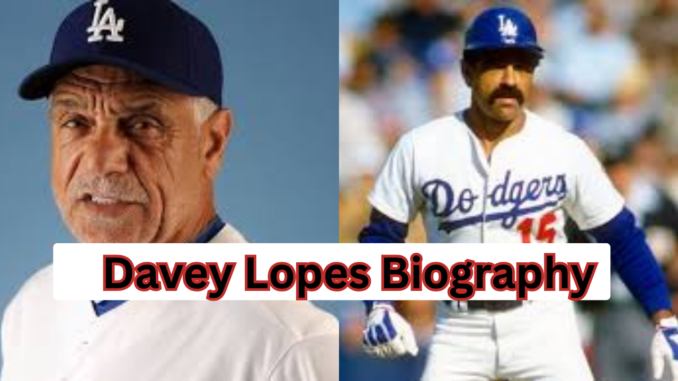
Biography
Davey Lopes was Born on May 3, 1945, in East Providence, Rhode Island, he grew up with a quiet personality but an intense love for sports. From a young age, baseball became more than just a game it became his path to recognition, discipline, and legacy.
Advertisements
Lopes attended La Salle Academy in Providence, where he first showed his athletic potential. But his journey was not a straight line to success. He faced challenges, including being overlooked early in his career. Yet, he never gave up. Instead, he used those setbacks as fuel. After playing college baseball at Iowa Wesleyan College and Washburn University, he slowly worked his way into professional baseball.
His breakthrough came when he was drafted by the Los Angeles Dodgers. Although he did not immediately become a star, his determination set him apart. Over time, he transformed from a quiet player into a confident leader, earning respect both on and off the field.
Lopes lived a long and impactful life, passing away on April 8, 2026, at the age of 80 in Providence, Rhode Island. His story is not just about baseball—it is about growth, resilience, and leaving a lasting mark.
Career
Davey Lopes had a career that spanned decades, filled with memorable moments, records, and achievements that still stand out today. He made his Major League Baseball debut on September 22, 1972, with the Los Angeles Dodgers at the age of 27. While that may seem late compared to many athletes, it proved that patience and persistence can still lead to greatness.
At the start of his career, Lopes was known for his quiet nature. But under the guidance of his manager, Tommy Lasorda, he began to develop confidence and leadership skills. This transformation played a huge role in shaping his career.
As a second baseman, Lopes became famous for his speed. He was one of the most effective base stealers in baseball history. Imagine a player who could change the entire pace of a game just by running—that was Davey Lopes. His 557 stolen bases remain one of the highest totals in MLB history, and his success rate was among the best ever recorded.
One of his most impressive achievements came in 1975 when he successfully stole 38 consecutive bases without being caught. This incredible record showed not just speed, but intelligence and timing. It made him a nightmare for opposing teams.
During his time with the Dodgers, Lopes was part of a legendary infield lineup alongside Steve Garvey, Bill Russell, and Ron Cey. Together, they formed one of the most stable and successful infields in baseball history.
Lopes earned multiple honors during his playing career. He was selected as an All-Star four times from 1978 to 1981. He also won a Gold Glove Award in 1978, proving his defensive excellence. In 1981, he helped the Dodgers win the World Series, marking one of the highest points of his career.
After leaving the Dodgers, Lopes continued playing for teams like the Oakland Athletics, Chicago Cubs, and Houston Astros. Even in his later years, he maintained strong performance levels, stealing bases even into his 40s—something very few players have achieved.
After retiring as a player in 1987, Lopes transitioned into coaching and management. He served as a coach for several teams, including the Texas Rangers, Baltimore Orioles, and San Diego Padres. In 2000, he became the manager of the Milwaukee Brewers.
Though his managerial record was mixed, his impact as a coach was undeniable. He was especially known for improving players’ base-stealing skills. During his time with the Philadelphia Phillies, the team achieved one of the highest stolen base success rates in MLB history.
Lopes officially retired from professional baseball after the 2017 season, closing a remarkable chapter in the sport.
Personal Life
Behind the success and statistics, Davey Lopes was a man with a rich and meaningful personal life. He came from a diverse background, with Cape Verdean and Irish roots, which shaped his identity and worldview.
Despite being a public figure, Lopes maintained a relatively private life. He was known for his humility and dedication to family. He believed strongly in discipline and hard work, values he carried from his early years into his professional life.
In 2008, Lopes faced a serious health challenge when he was diagnosed with prostate cancer. Instead of hiding it, he confronted it with courage. His recovery became a source of inspiration for many fans and athletes facing similar struggles.
Later in life, Lopes also dealt with Parkinson’s disease, a condition that gradually affected his health. Even then, he remained strong and continued to be respected in the baseball community.
He passed away peacefully in 2026, leaving behind not just memories of great games, but a legacy of resilience and character.
Family
Family played an important role in Davey Lopes’ life. While much of his public identity was tied to baseball, those close to him knew him as a devoted family man.
He valued his roots and often spoke about the importance of staying grounded, no matter how successful one becomes. His upbringing in Rhode Island helped shape his strong sense of responsibility and humility.
Although detailed information about his immediate family life is not widely publicized, Lopes maintained close relationships with his loved ones throughout his life. He also gave back to his community, including having a recreation center named after him in Providence—a sign of how much he meant to the people around him.
Age
Davey Lopes lived a full and accomplished life. Born on May 3, 1945, he reached the age of 80 before his passing on April 8, 2026.
His longevity in both life and career is something worth noting. Many athletes fade away quickly after retirement, but Lopes remained active in baseball for decades as a coach and mentor. His experience and knowledge continued to influence the game long after his playing days were over.
Net Worth
Davey Lopes built his wealth through years of dedication to baseball, both as a player and a coach. While exact figures may vary, his net worth is estimated to have been in the range of several million dollars.
His earnings came from player contracts, coaching roles, and managerial positions. Beyond money, however, his true wealth lay in his reputation. He was widely respected in the baseball world, and his contributions to the sport added lasting value that goes far beyond financial figures.
Cause of Death
Davey Lopes passed away on April 8, 2026, due to complications from Parkinson’s disease.
Parkinson’s is a progressive condition that affects movement and overall health. Lopes battled this illness with the same strength and determination he showed on the baseball field.
His death marked the end of an era for many fans who had followed his career for decades. Yet, his legacy continues to live on through his achievements and the players he mentored.
Conclusion
Davey Lopes’ life story is one of persistence, growth, and impact. From a quiet young athlete in Rhode Island to a legendary figure in Major League Baseball, his journey shows what is possible when talent meets determination.
He was not just a player who stole bases—he was someone who changed games, inspired teammates, and influenced generations of athletes. Even after retiring, his role as a coach ensured that his knowledge and passion for baseball would continue to shape the sport.
His passing in 2026 was a significant loss, but his legacy remains strong. When you think about speed, intelligence, and leadership in baseball, Davey Lopes is a name that will always come to mind.
FAQs
Who was Davey Lopes?
Davey Lopes was an American Major League Baseball player, coach, and manager known for his speed and base-stealing ability.
How many bases did Davey Lopes steal in his career?
He stole 557 bases during his MLB career, making him one of the top base stealers in history.
What teams did Davey Lopes play for?
He played for the Los Angeles Dodgers, Oakland Athletics, Chicago Cubs, and Houston Astros.
What caused Davey Lopes’ death?
He died from complications related to Parkinson’s disease in April 2026.
Did Davey Lopes win a World Series?
Yes, he won the World Series with the Los Angeles Dodgers in 1981 and later as a coach in 2008.

Peter Charles is a journalist and writer who covers battery-material recycling, urban mining, and the growing use of microreactors in industry. With 10 years of experience in industrial reporting, he explains new technologies and industry changes in clear, simple terms. He holds both a BSc and an MSc in Electrical Engineering, which gives him the technical knowledge to report accurately and insightfully on these topics.