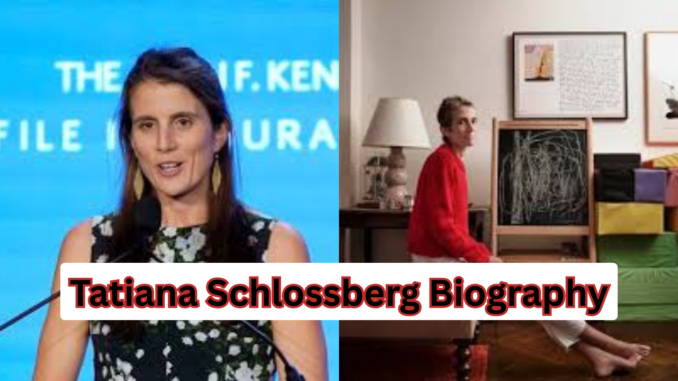
Biography
Tatiana Schlossberg was a woman who carried history in her name but chose to build her own legacy with words, curiosity, and purpose. Born Tatiana Celia Kennedy Schlossberg on May 5, 1990, in Lenox Hill, New York, she entered the world surrounded by stories that shaped modern America. She was the daughter of designer and artist Edwin Schlossberg and Caroline Kennedy, the diplomat, author, and only surviving child of President John F. Kennedy and First Lady Jacqueline Kennedy Onassis. From the very beginning, Tatiana was part of the famous Kennedy family, a lineage known for public service, tragedy, resilience, and influence.
Growing up in New York City, Tatiana’s childhood blended privilege with strong expectations. Her parents were deeply committed to education, creativity, and civic responsibility, and those values became part of her daily life. She was raised mainly on Manhattan’s Upper East Side, but she also spent long stretches of time on Martha’s Vineyard, a place deeply tied to her family’s history. The island offered her a sense of calm and connection to nature that would later influence her environmental writing.
Despite her famous last name, Tatiana was known for being thoughtful, grounded, and intensely private. Friends often described her as observant and reflective, someone who listened more than she spoke. While the public associated the Kennedy name with politics and power, Tatiana leaned toward ideas, research, and storytelling. She was curious about how people lived, how systems worked, and how human behavior quietly shaped the planet.
Her upbringing exposed her to different cultures, faiths, and traditions. Her father came from an Orthodox Jewish family of Ashkenazi descent, while her mother was Catholic, with Irish, French, Scottish, and English roots. Tatiana was raised Catholic, though her home embraced Jewish traditions as well, especially during holidays. This blending of backgrounds helped shape her open-minded worldview and her interest in understanding complexity rather than simplifying it.
Tatiana Schlossberg grew up knowing she could not hide from history, but she also learned that she did not have to repeat it. Instead of stepping directly into politics, she chose journalism and environmental advocacy as her path, believing that information, honesty, and awareness could be just as powerful as policy.
Advertisements
Career
Tatiana Schlossberg’s career was driven by a deep belief that stories could change how people think and act. After completing her undergraduate studies at Yale University, where she earned a Bachelor of Arts in History in 2012, she showed early signs of her journalistic talent. At Yale, she wrote for the Yale Herald and eventually became its editor-in-chief, sharpening her voice and learning how to ask difficult questions without losing empathy.
Her academic journey continued at the University of Oxford, where she earned a master’s degree in American history in 2014. Oxford refined her research skills and gave her a broader perspective on global issues, particularly how history, policy, and human behavior intersect over time.
Tatiana’s professional journalism career began modestly, not with headlines but with groundwork. She interned at the Vineyard Gazette in Massachusetts and later worked as a municipal reporter at The Record in New Jersey. These early roles taught her how to cover real communities, local government, and everyday concerns. She learned that the most meaningful stories are often the ones closest to home.
In 2014, she joined The New York Times as a summer intern, a competitive program reserved for a small number of promising journalists. Her talent and discipline stood out, and she was eventually hired as a reporter. At the Times, she covered the Metro section before moving into science and climate reporting. This shift marked a turning point in her career.
Tatiana became known for explaining environmental issues in a way that felt personal and urgent without being alarmist. She wrote about climate change, pollution, consumer habits, and the hidden costs of modern life. Her reporting focused on the small, everyday choices people make and how those choices ripple outward, affecting ecosystems and future generations. She did not preach. Instead, she invited readers to look at themselves honestly.
In 2019, Tatiana published her first and only book, Inconspicuous Consumption: The Environmental Impact You Don’t Know You Have. The book explored how ordinary actions, like sending emails, buying clothes, or streaming videos, contribute to environmental damage. It was praised for its clarity, accessibility, and refusal to shame readers. The book won first place in the Society of Environmental Journalists’ Rachel Carson Environment Book Award in 2020, confirming her place as a leading voice in environmental journalism.
Beyond writing, Tatiana participated in public discussions, award ceremonies, and educational events. She often appeared alongside her mother at international engagements, quietly supporting diplomatic and cultural initiatives. Even in these settings, she remained focused on her work rather than her name.
Personal Life
Tatiana Schlossberg’s personal life was marked by love, intellectual partnership, and quiet strength. In September 2017, she married George Moran, a physician she had met while both were students at Yale. Their relationship was built on mutual respect, shared values, and a deep understanding of each other’s ambitions. They married at the family’s estate on Martha’s Vineyard, surrounded by close family and friends rather than spectacle.
Together, Tatiana and George built a life centered on learning, service, and family. They welcomed their first child, a son, in 2022, followed by a daughter in 2024. Motherhood added a new layer to Tatiana’s life, one filled with joy but also sharpened awareness of the future. Friends noted that becoming a parent made her environmental concerns even more personal, as she now thought constantly about the world her children would inherit.
Tatiana valued privacy, especially when it came to her children. She avoided social media exposure and public commentary about her family life. For her, home was a sanctuary, a place to rest from the weight of public attention and the demands of her work.
In 2024, shortly after the birth of her daughter, Tatiana received devastating news. She was diagnosed with acute myeloid leukemia, a fast-moving and aggressive form of blood cancer. What began as hope for treatment gradually turned into a fight defined by courage and honesty.
In November 2025, Tatiana published a deeply personal essay revealing that her leukemia carried a rare mutation known as Inversion 3, making it terminal. She wrote openly about fear, acceptance, and love, offering readers a raw look at mortality. Even in illness, she remained a storyteller, using her voice to help others feel less alone.
Cause of Death
Tatiana Schlossberg died on December 30, 2025, at the age of 35. Her death was caused by complications related to acute myeloid leukemia. Despite undergoing chemotherapy, a bone marrow transplant, and a clinical trial involving CAR-T cell therapy, the disease progressed rapidly.
Her family announced her passing through the John F. Kennedy Library Foundation, asking for privacy while honoring her life and work. The news resonated deeply across journalism, environmental advocacy, and the many communities she had touched through her writing.
Tatiana’s death was not only a personal loss to her family but also a professional loss to environmental journalism. She represented a rare blend of intellect, empathy, and moral clarity. Her passing reminded many that even the brightest voices can be taken too soon, but their impact can continue long after.
Family
Family was central to Tatiana Schlossberg’s identity. She was the granddaughter of President John F. Kennedy and Jacqueline Kennedy Onassis, a legacy that came with both inspiration and burden. Her mother, Caroline Kennedy, served as U.S. Ambassador to Japan and Australia, and her father, Edwin Schlossberg, was a respected designer and author.
Tatiana was close to her siblings, Rose and Jack Schlossberg. While each pursued different paths, they shared a strong bond rooted in shared history and mutual support. The Schlossberg-Kennedy family emphasized education, service, and compassion, values Tatiana carried into her own life.
As a wife and mother, Tatiana created a new branch of that family legacy, one defined less by public office and more by thoughtful engagement with the world. Her children remain a living part of her story, symbols of continuity and hope.
Conclusion
Tatiana Schlossberg lived a life that proved legacy is not only inherited, it is earned. She took the weight of her famous name and transformed it into a platform for truth, responsibility, and care for the planet. Through her journalism, her book, and her honesty in the face of death, she reminded the world that small actions matter and that courage often looks quiet.
Though her life was tragically short, her impact was lasting. Tatiana Schlossberg did not chase attention. She chased understanding. And in doing so, she left behind a body of work that will continue to inspire readers to think differently about the world they shape every day.
FAQs
Who was Tatiana Schlossberg?
Tatiana Schlossberg was an American environmental journalist and author, known for her climate reporting and her book Inconspicuous Consumption.
What was Tatiana Schlossberg’s cause of death?
She died from complications related to acute myeloid leukemia at the age of 35.
Was Tatiana Schlossberg part of the Kennedy family?
Yes, she was the granddaughter of President John F. Kennedy and Jacqueline Kennedy Onassis.
What was Tatiana Schlossberg’s book about?
Her book focused on the hidden environmental impact of everyday consumer habits and modern lifestyles.
Did Tatiana Schlossberg have children?
Yes, she had two children, a son born in 2022 and a daughter born in 2024.

Peter Charles is a journalist and writer who covers battery-material recycling, urban mining, and the growing use of microreactors in industry. With 10 years of experience in industrial reporting, he explains new technologies and industry changes in clear, simple terms. He holds both a BSc and an MSc in Electrical Engineering, which gives him the technical knowledge to report accurately and insightfully on these topics.
Leave a Reply