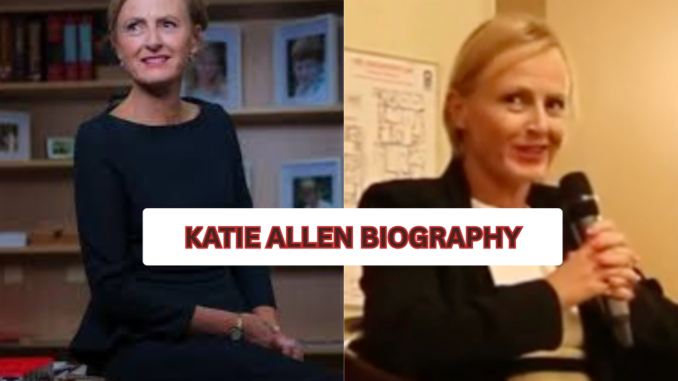
Biography
Katie Allen, born Katrina Jane Stephens on 24 February 1966, came into the world in Albury, New South Wales, Australia. From the very beginning, her life was surrounded by public service, education, and politics. Her mother was actively involved in the Liberal Party at a local level, while her broader family history included deep roots in Australia’s winemaking industry.
Growing up in country New South Wales gave Allen a grounded upbringing. But her academic path soon took her far beyond rural Australia. She attended Melbourne Girls Grammar, a school known for shaping strong female leaders. Even as a student, Allen stood out—not because she was loud, but because she was focused. She wasn’t chasing popularity; she was chasing purpose.
Her academic journey led her to Monash University, where she studied medicine. Later, she undertook advanced research at the University of Cambridge and completed her medical training at The Alfred Hospital. In 2002, she earned a PhD from the University of Melbourne, focusing on liver cell transplantation. That alone puts her in rare company—few politicians anywhere in the world enter parliament with such a strong scientific background.
In short, before politics ever entered the picture, Katie Allen had already built a reputation as a serious thinker and medical professional.
Career
Medical and Research Career
Katie Allen’s professional life began not in parliament, but in hospitals and research labs. From 1998, she worked as a paediatric allergist and gastroenterologist at the Royal Children’s Hospital in Melbourne. Her work focused on children with complex digestive and immune conditions—cases where lives literally depended on precision and care.
Advertisements
One of her most ambitious medical milestones came in 2004, when she led Australia’s first liver cell transplantation. Although the procedure was ultimately unsuccessful, Allen did something rare in both science and politics—she acknowledged the limits of the method and published evidence showing the technique wasn’t yet ready for widespread use. That honesty earned her respect in academic circles.
In 2013, Allen became the Director of the Centre for Food and Allergy Research at the Murdoch Children’s Research Institute. She also led the famous HealthNuts Study, tracking over 5,000 children to better understand food allergies. Her work influenced national infant feeding guidelines and reshaped how Australia thinks about allergy prevention.
Political Career
Politics came later—and not without resistance. Allen first ran for state office in 2018, contesting the seat of Prahran. She lost, but the experience opened the door to federal politics.
In 2019, she won the federal seat of Higgins for the Liberal Party, becoming a Member of the Australian Parliament. Her win came during a time when inner-city voters were shifting away from traditional parties, making her victory both surprising and hard-fought.
In parliament, Allen focused on:
- Health policy
- COVID-19 response
- Climate action
- Medical research funding
- Education reform
She served on multiple parliamentary committees and advised the government during the pandemic. However, her time in parliament was brief. In 2022, she lost her seat to Labor’s Michelle Ananda-Rajah, becoming the first Liberal MP to ever lose Higgins.
She attempted a political comeback in 2025, but the abolition of Higgins and internal party tensions made the path rocky.
Personal Life
Away from the spotlight, Katie Allen was first and foremost a wife and mother. She was married to Malcolm Allen, and together they raised four children. The family settled in Toorak, Victoria, balancing demanding careers with home life.
Friends often described Allen as disciplined but warm—someone who didn’t waste words but listened carefully. Despite her public profile, she guarded her family’s privacy closely. Politics was part of her life, not her entire identity.
In 2025, Allen revealed that she had been quietly battling cholangiocarcinoma, a rare and aggressive cancer of the bile duct. She had been diagnosed in November 2023 but chose not to make her illness public while campaigning. That decision spoke volumes about her character—she didn’t want sympathy votes, only honest judgment.
Controversies
No public figure escapes controversy, and Katie Allen was no exception.
Within her own party, she was often seen as too moderate. She openly supported stronger climate policies, backed LGBTQ+ protections, and crossed the floor on transgender student protections—moves that upset conservative colleagues.
Her support for nuclear energy also drew criticism, especially from environmental groups. Allen argued that nuclear power deserved open discussion as part of a carbon-neutral future, a stance that sparked intense debate.
Another point of tension came during internal party reshuffles ahead of the 2025 election, when her candidacy reportedly caused anger among local party members who felt sidelined.
Yet through it all, Allen maintained a calm public demeanor. She didn’t thrive on conflict; she endured it.
Age
Katie Allen was 59 years old at the time of her death. She lived nearly six decades filled with academic excellence, public service, and personal sacrifice. While some politicians peak late, Allen’s life reminds us that impact isn’t measured by longevity alone—it’s measured by influence.
Cause of Death
Katie Allen passed away on 23 December 2025 in Melbourne, Victoria, after a prolonged battle with cholangiocarcinoma, a rare cancer affecting the bile ducts.
This form of cancer is notoriously difficult to detect early and often aggressive. Despite access to world-class medical care and her own deep understanding of medicine, the disease progressed.
Her death marked the quiet end of a life devoted to improving others’ health—an irony not lost on those who admired her work. Tributes described her as principled, intelligent, and deeply committed to evidence-based decision-making.
Conclusion
Katie Allen’s story isn’t one of political dominance or loud victories. It’s a story of service over spotlight, science over slogans, and integrity over convenience. She walked the rare line between medicine and politics, bringing evidence into a space often ruled by ideology.
In the end, Katie Allen leaves behind more than policies or speeches—she leaves a legacy of thoughtful leadership and a reminder that public service can still be grounded in knowledge, compassion, and courage.
FAQs
Who was Katie Allen?
Katie Allen was an Australian medical researcher and politician who served as a Liberal MP for Higgins from 2019 to 2022.
How old was Katie Allen when she died?
She was 59 years old at the time of her death in December 2025.
What was Katie Allen known for before politics?
She was a respected paediatric allergist and medical researcher, leading major studies on food allergies in children.
What controversies surrounded Katie Allen?
She faced criticism for her moderate political views, support for nuclear energy, and crossing the floor on transgender student protections.
What was Katie Allen’s cause of death?
Katie Allen died from cholangiocarcinoma, a rare and aggressive cancer of the bile duct.

Peter Charles is a journalist and writer who covers battery-material recycling, urban mining, and the growing use of microreactors in industry. With 10 years of experience in industrial reporting, he explains new technologies and industry changes in clear, simple terms. He holds both a BSc and an MSc in Electrical Engineering, which gives him the technical knowledge to report accurately and insightfully on these topics.
Leave a Reply