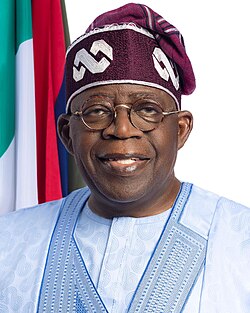
Bola Ahmed Tinubu is one of the most influential and powerful political figures in Nigeria’s modern history. He is the 16th and current President of Nigeria, having assumed office on 29 May 2023. Before becoming president, Tinubu built a long political career as a senator, governor of Lagos State, party leader, and political strategist. Many people regard him as a major architect of contemporary Nigerian politics, especially in the South-West.
Often referred to by his traditional title “Asiwaju”, Bola Tinubu is admired by supporters for his political intelligence and reforms in Lagos, while critics point to controversies that have followed him for decades. This extensive biography explains his background, education, political rise, personal life, and the controversies surrounding him, using clear and simple English.
Biography
Bola Ahmed Adekunle Tinubu was born on 29 March 1952 in Lagos, which was then part of British Nigeria. He comes from a Yoruba Muslim family. His mother, Abibatu Mogaji, was a respected trader and later became the Ìyálọ́jà of Lagos, a powerful traditional position among market leaders in the city.
Tinubu spent his early life in southwestern Nigeria, where he was raised with strong cultural, religious, and community values. His background in Lagos exposed him to commerce, politics, and leadership from a young age. Over time, he developed a reputation for ambition and strategic thinking.
Although his year of birth has sometimes been disputed by political opponents, most reliable records confirm that he was born in 1952. Tinubu himself has consistently maintained this date.
Advertisements
His journey from a modest upbringing to becoming Nigeria’s president reflects decades of persistence, political maneuvering, and deep involvement in national affairs.
Education
Bola Tinubu’s education took place in both Nigeria and the United States, giving him early international exposure.
He began his schooling at St. John’s Primary School, Aroloya, Lagos, before continuing at Children’s Home School in Ibadan. These early years helped shape his academic discipline and curiosity.
In 1975, Tinubu moved to the United States to pursue higher education. He first attended Richard J. Daley College in Chicago before transferring to Chicago State University. While studying, he supported himself by working several jobs, including as a dishwasher, night security guard, and taxi driver.
At Chicago State University, Tinubu studied Accounting and Management. He performed well academically, made the Dean’s List, and even taught remedial classes to fellow students. He also served as President of the University Accounting Society during his final year.
In 1979, Tinubu graduated summa cum laude with a Bachelor of Science in Business Administration. His strong academic background later played a role in his work as an accountant, corporate executive, and public finance reformer.
Career
Early Professional Career
After graduating, Bola Tinubu worked as an accountant in the United States for major firms, including Arthur Andersen, Deloitte, and GTE Services Corporation. At Deloitte, he gained experience in auditing and consulting for large corporations.
He later worked with Saudi Aramco’s joint venture partner, helping to set up accounting systems. This period marked his first major financial success.
Tinubu eventually moved to London, where he worked as an auditor for Mobil Oil UK, before returning to Nigeria to join Mobil Producing Nigeria Unlimited (now Seplat Energy). In Nigeria, he became a senior executive and treasurer in the 1980s.
Despite a successful corporate career, Tinubu decided to leave the private sector to fully pursue politics.
Early Political Career and Senate Years
Tinubu entered politics in 1991 under the Social Democratic Party (SDP). In 1992, he was elected Senator for Lagos West during Nigeria’s Third Republic. In the Senate, he chaired committees on Banking, Finance, Appropriation, and Currency, earning recognition for his knowledge of public finance.
After the June 12, 1993 presidential election was annulled, Tinubu became a key member of the National Democratic Coalition (NADECO), which fought against military rule. When General Sani Abacha took power, Tinubu faced arrests and threats, forcing him into exile in 1994.
He returned to Nigeria in 1998, following Abacha’s death and the return to democratic rule.
Governor of Lagos State (1999–2007)
In 1999, Tinubu was elected Governor of Lagos State under the Alliance for Democracy (AD). He was re-elected in 2003, becoming the only South-West governor to survive the dominance of the then-ruling PDP.
As governor, Tinubu introduced major reforms in:
- Road construction and infrastructure
- Tax administration and revenue generation
- Public sector reforms
He frequently clashed with the federal government, especially over the creation of Local Council Development Areas (LCDAs). Despite federal opposition, a Supreme Court ruling later favored Lagos State.
His tenure ended in 2007, and he was succeeded by Babatunde Fashola, his former chief of staff.
National Political Influence and Presidency
After leaving office, Tinubu became a key opposition leader. He played a major role in forming the All Progressives Congress (APC) in 2013, uniting several opposition parties.
He supported Muhammadu Buhari in the 2015 and 2019 elections, which ended PDP’s long rule. In January 2022, Tinubu officially declared his intention to run for president.
In June 2022, he won the APC presidential primary. In March 2023, he was declared the winner of the presidential election and sworn in on 29 May 2023 as Nigeria’s 16th president.
As president, Tinubu immediately:
- Removed fuel subsidy
- Introduced major economic reforms
- Suspended top officials like the Central Bank Governor
- Began restructuring Nigeria’s security and financial systems
Personal Life
Bola Tinubu married Oluremi Tinubu in 1987. She is a former senator representing Lagos Central and later became First Lady of Nigeria in 2023.
Tinubu has six children. Three were born from previous relationships, including Oluwaseyi Tinubu, while three are from his marriage to Remi Tinubu. One of his sons, Jide Tinubu, died in 2017.
Tinubu is a Muslim and maintains strong ties to traditional institutions. He holds several chieftaincy titles and is deeply involved in Yoruba cultural life.
Controversies
Bola Tinubu’s career has been marked by major controversies.
Corruption Allegations
In 1993, U.S. authorities seized funds from Tinubu’s accounts after alleging links to drug-related proceeds. Tinubu later settled the case by forfeiting money, though the matter remains a frequent subject of political debate.
He has also faced investigations over foreign bank accounts, bullion van incidents, and allegations of financial impropriety, many of which he has denied or survived legally.
Godfatherism and Lagos Politics
Tinubu is often described as the “Godfather of Lagos politics”. Critics accuse him of controlling political outcomes in the state, while supporters say he ensures stability and continuity.
Presidency Controversies
His presidency has faced criticism over:
- Fuel subsidy removal
- Currency reforms
- Alleged nepotism
- Election irregularities
Despite these, his government has maintained international recognition and legitimacy.
Conclusion
Bola Ahmed Tinubu’s life is a story of ambition, resilience, and political dominance. From accountant to senator, governor, party builder, and finally president, his influence on Nigeria is undeniable. While controversies continue to shape public opinion, his role in redefining Nigerian politics will remain significant for decades.
Whether viewed as a master strategist or a polarizing figure, Bola Tinubu stands as one of the most consequential leaders in Nigeria’s history.
Frequently Asked Questions (FAQs)
1. Who is Bola Ahmed Tinubu?
He is the 16th President of Nigeria and a former governor of Lagos State.
2. When did Bola Tinubu become president?
He assumed office on 29 May 2023.
3. What is Bola Tinubu’s educational background?
He studied accounting and management at Chicago State University.
4. What is Bola Tinubu known for politically?
He is known for Lagos reforms, party building, and forming the APC.
5. Why is Bola Tinubu controversial?
He has faced corruption allegations, political dominance claims, and election disputes over the years.

Peter Charles is a journalist and writer who covers battery-material recycling, urban mining, and the growing use of microreactors in industry. With 10 years of experience in industrial reporting, he explains new technologies and industry changes in clear, simple terms. He holds both a BSc and an MSc in Electrical Engineering, which gives him the technical knowledge to report accurately and insightfully on these topics.
Leave a Reply