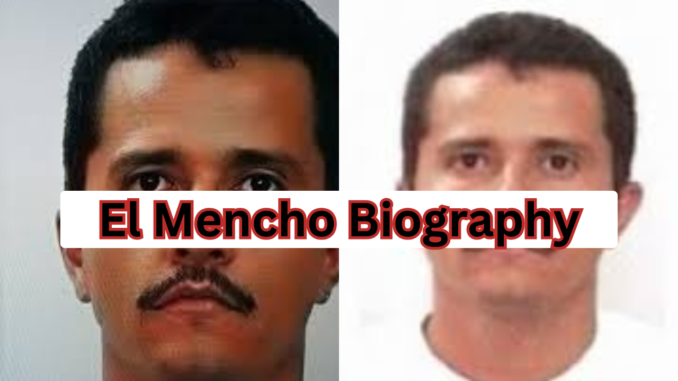
Biography
El Mencho, was born on 17 July 1966 in the rural community of Aguililla, Michoacán, Mexico. He grew up in poverty in a farming family that cultivated avocados. His early life was marked by hardship, limited education, and few economic opportunities. He dropped out of primary school in the fifth grade to work in the fields and help support his family.
Advertisements
As a teenager, he reportedly guarded marijuana plantations. In the 1980s, seeking a better life, he immigrated illegally to California in the United States. During his time in the U.S., he used different names to conceal his identity. He was arrested multiple times for drug-related crimes and firearm possession. Eventually, he was deported to Mexico in the early 1990s after serving prison time in the United States.
After returning to Mexico, El Mencho briefly joined local police forces in Jalisco. However, he later entered organized crime and became involved with the Milenio Cartel. His intelligence, caution, and ability to adapt helped him rise quickly. When key cartel leaders were arrested or killed, he took advantage of the power vacuum.
He later founded and led the Jalisco New Generation Cartel (CJNG), transforming it into one of the most powerful and violent criminal organizations in Mexico. At the height of his power, he was considered the most wanted man in Mexico and one of the most wanted criminals in the United States.
El Mencho died on 22 February 2026 at the age of 59 during a military operation in Tapalpa, Jalisco.
Career
El Mencho’s criminal career began in the 1990s after his deportation from the United States. He joined the Milenio Cartel and worked closely with its leaders. Through loyalty and calculated moves, he earned trust and influence.
When the Milenio Cartel began to weaken after several arrests of top leaders, El Mencho moved strategically. Internal conflicts split the group into factions. One faction became known as Los Mata Zetas, which he led. This group later evolved into the Jalisco New Generation Cartel (CJNG).
Under his leadership, the CJNG expanded aggressively across Mexico. The cartel gained control in several states including Jalisco, Colima, Guanajuato, Veracruz, and Michoacán. It fought rival groups like Los Zetas and the Knights Templar Cartel.
El Mencho was known for using extreme violence to intimidate both rivals and government forces. His organization carried out ambushes, road blockades, and even shot down a military helicopter in 2015. These bold attacks increased his notoriety.
Internationally, the CJNG expanded its operations into the United States, Latin America, Europe, Asia, and Africa. The cartel focused mainly on cocaine, heroin, and methamphetamine trafficking. U.S. authorities accused El Mencho of coordinating large-scale drug shipments across continents.
The U.S. government offered up to $15 million for information leading to his arrest, while Mexico offered hundreds of millions of pesos. Despite years of manhunts, he managed to avoid capture until his death in 2026.
Personal Life
Despite his violent public image, El Mencho was believed to live a relatively modest and cautious lifestyle compared to other drug lords. Authorities suspected he constantly moved between rural mountain areas in Jalisco and nearby states to avoid arrest.
He came from a large family and had five brothers. Several of his relatives were later arrested for involvement in cartel activities. His family connections played a major role in building and maintaining the CJNG’s financial and operational structure.
Reports also suggested that he suffered from kidney disease in later years. Some intelligence sources claimed he built medical facilities in remote areas to treat his condition privately. However, he rarely appeared in public during his final years.
El Mencho’s leadership style was described as strategic but ruthless. He valued loyalty and punished betrayal severely. His organization relied on both family members and trained armed groups for protection.
Wife
El Mencho married Rosalinda González Valencia in 1996. She came from a family linked to organized crime networks. Their marriage strengthened his ties within criminal circles.
Rosalinda was later accused by authorities of playing a financial role within the CJNG. She was arrested multiple times on money laundering charges. Although she was released on bail in 2018, she continued to face legal proceedings.
The couple had three children, including Rubén Oseguera González, known as “El Menchito,” who was considered a high-ranking member of the CJNG before his arrest and extradition to the United States.
El Mencho’s family network became deeply connected to the cartel’s operations. Several relatives were sanctioned or arrested for financial crimes and drug trafficking.
Age
El Mencho was born on 17 July 1966 and died on 22 February 2026. He was 59 years old at the time of his death.
His life spanned decades of Mexico’s drug war. From a poor farmer’s son in Michoacán to one of the most wanted criminals in the world, his journey reflects the deep social and criminal challenges in modern Mexico.
Cause of His Death
El Mencho died from gunshot wounds during a military operation carried out by Mexican security forces in Tapalpa, Jalisco, on 22 February 2026.
At the time of his death, he was still considered Mexico’s most wanted fugitive. Authorities had pursued him for years through coordinated intelligence operations. His death marked the end of one of the most intense manhunts in recent Mexican history.
News of his death spread quickly. Given his high-profile status, information was initially updated rapidly by authorities and media outlets. His killing was seen as a major event in Mexico’s ongoing battle against organized crime.
Net Worth
Estimating El Mencho’s net worth has always been difficult because his wealth was hidden through illegal networks, shell companies, and money laundering operations.
In 2019, U.S. officials suggested that his personal fortune could be at least $500 million, and possibly more than $1 billion. Government estimates placed the CJNG’s total assets at tens of billions of dollars globally.
The cartel invested in businesses such as restaurants, agricultural companies, advertising firms, and real estate. Many of these businesses were later sanctioned under the U.S. Kingpin Act, which froze assets and prohibited U.S. citizens from engaging with them.
His wealth came mainly from drug trafficking operations involving cocaine, methamphetamine, and heroin shipments across multiple continents.
Conclusion
The life of Nemesio Oseguera Cervantes, known as El Mencho, is a story of poverty, ambition, violence, and power. Born in rural Mexico, he rose through the ranks of organized crime to become the leader of the Jalisco New Generation Cartel. Under his command, the CJNG became one of the most powerful criminal organizations in the world.
His reign was marked by extreme violence, international drug trafficking, and relentless manhunts. Governments in Mexico and the United States invested enormous resources into capturing him. After years in hiding, he was killed in 2026 during a military operation.
His death may have ended his personal story, but the impact of his actions continues to shape Mexico’s ongoing struggle against organized crime.
FAQs
Who was El Mencho?
El Mencho was the alias of Nemesio Oseguera Cervantes, a Mexican drug lord and leader of the Jalisco New Generation Cartel.
How did El Mencho die?
He died from gunshot wounds during a Mexican military operation in Jalisco on 22 February 2026.
How old was El Mencho when he died?
He was 59 years old at the time of his death.
Who was El Mencho’s wife?
His wife was Rosalinda González Valencia, who was accused of involvement in cartel-related financial activities.
What was El Mencho’s net worth?
His estimated personal net worth ranged from $500 million to over $1 billion, though exact figures are unknown due to hidden assets and illegal operations.

Peter Charles is a journalist and writer who covers battery-material recycling, urban mining, and the growing use of microreactors in industry. With 10 years of experience in industrial reporting, he explains new technologies and industry changes in clear, simple terms. He holds both a BSc and an MSc in Electrical Engineering, which gives him the technical knowledge to report accurately and insightfully on these topics.