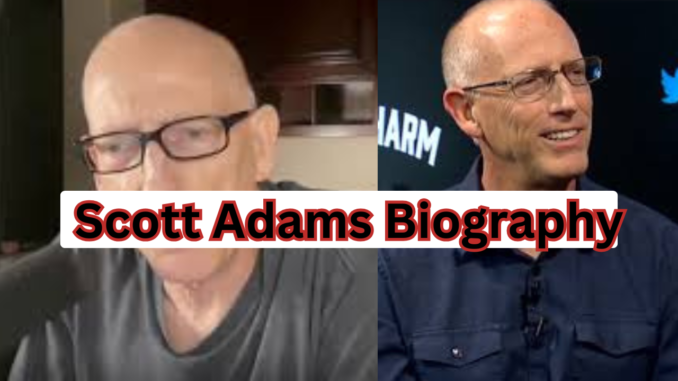
Biography
Scott Raymond Adams was a man who turned everyday office frustration into a global mirror. Born on June 8, 1957, in Windham, New York, Scott Adams grew up in a modest American environment where imagination became his early escape. As a child, he was already fascinated by comic strips, especially Peanuts. At just six years old, he began drawing comics, and by age eleven, he had already won a drawing competition. Was this the first quiet signal of a future that would eventually speak to millions of office workers around the world?
Advertisements
Adams was not just creative; he was academically gifted. He graduated as the valedictorian of his high school class in 1975, a class of only 39 students, but his ambition was far larger than his surroundings. He went on to earn a Bachelor of Arts degree in economics from Hartwick College in 1979. Later, after moving to California and working in corporate America, he completed an MBA at the University of California, Berkeley, in 1986. This blend of creativity and business education would later define his unique voice.
His early life was shaped by discipline, curiosity, and observation. Like a sponge soaking up human behavior, Adams studied how people talked, how managers made decisions, and how systems often failed the people inside them. These observations would one day become the backbone of Dilbert, a comic strip that felt less like fiction and more like a documentary drawn in ink.
Career
Before becoming a full-time cartoonist, Scott Adams lived the very corporate life he would later satirize. He worked at Crocker National Bank and later at Pacific Bell, holding roles that ranged from teller and programmer to product manager and supervisor. He even experienced armed robberies while working as a bank teller, moments that likely sharpened his awareness of how fragile and absurd systems can be.
During this period, Adams woke up at 4 a.m. every day, experimenting with different career paths. Cartooning, slowly but surely, rose above the rest. In 1989, while still employed at Pacific Bell, he launched Dilbert. The strip focused on the frustrations of office workers, the emptiness of corporate jargon, and the quiet despair of meaningless meetings. It was as if Adams had cracked open the skull of corporate culture and let everyone see what was inside.
At first, success came slowly. His initial royalty check was just a few hundred dollars. But by the early 1990s, Dilbert was syndicated in hundreds of newspapers. By the mid-1990s, it appeared in thousands of papers across dozens of countries. Adams became a full-time cartoonist in 1995, leaving behind corporate life for good.
His success did not stop with comics. In 1996, he published The Dilbert Principle, a book that humorously argued that companies tend to promote incompetent employees into management. The book became a bestseller and cemented Adams as not just a cartoonist, but a cultural commentator. He went on to write many other books, including God’s Debris, The Religion War, and Loserthink, exploring philosophy, belief systems, persuasion, and flawed thinking.
In 1999, Dilbert was adapted into a television series that ran for two seasons and won a Primetime Emmy Award. Adams served as executive producer, further expanding his influence. By the early 2000s, he was one of the most recognized cartoonists in the world.
In the mid-2010s, Adams reinvented himself again, this time as a political and social commentator. His daily show, Real Coffee with Scott Adams, attracted a large online audience. He discussed persuasion, politics, and current events, often through a controversial lens. Some praised his honesty, while others criticized his views. Was he a fearless truth-teller, or a provocateur pushing boundaries too far? The answer depended largely on who was listening.
In 2023, Adams made remarks on his YouTube channel that were widely described as racist. As a result, many newspapers dropped Dilbert, and its distributor cut ties with him. Adams denied being racist and defended his comments, but the damage was done. He relaunched Dilbert as a webcomic on his Locals platform, continuing to write until physical illness limited his ability to draw.
Personal Life
Behind the public figure was a man shaped by relationships, loss, and self-belief. Scott Adams married Shelly Miles in 2006. The ceremony took place aboard a yacht in San Francisco Bay, a setting that reflected his unconventional style. Adams became a stepfather to Miles’ two children. Tragedy struck in 2018 when his stepson Justin died of a fentanyl overdose at the age of 18. This loss deeply affected Adams and influenced his later views on society and responsibility.
Adams and Miles divorced in 2014 but remained on friendly terms. In 2020, Adams married Kristina Basham, a model and baker. Their marriage ended in divorce in 2022. Adams had no biological children.
He was known for his belief in affirmations and mental focus. Adams claimed that writing down goals daily and visualizing success played a major role in his achievements. He even wove these ideas into Dilbert, turning personal philosophy into public humor.
Adams also explored religion and spirituality throughout his life. Long known as agnostic, he approached belief systems with skepticism and curiosity. Shortly before his death, he announced his intention to convert to Christianity, describing the decision as a rational calculation rather than an emotional one. Was this a final philosophical experiment, or a sincere shift at the edge of life? Perhaps it was both.
Cause of Death
Scott Adams’ final years were marked by serious illness. In May 2025, he revealed that he had advanced prostate cancer that had spread to his bones. Despite trying various treatments, including unconventional ones, the disease progressed. By late 2025, the cancer had spread to his spine, leaving him in immense pain and eventually paralyzed below the waist.
Adams spoke openly about his condition on his podcast, discussing physician-assisted suicide, pain management, and the reality of dying. These conversations were raw, reflective, and consistent with a man who had always chosen transparency over comfort.
On January 13, 2026, Scott Adams died at the age of 68 while under hospice care in Pleasanton, California. His death marked the end of a career that spanned nearly four decades and reshaped how millions viewed office life.
Conclusion
Scott Adams was a complex figure, much like the corporate systems he mocked. He was a cartoonist, author, commentator, and provocateur. To some, he was a voice of reason and humor; to others, a source of controversy. Yet, his impact is undeniable. Dilbert became a shared language for office workers worldwide, a comic strip that felt less like entertainment and more like therapy. Adams’ life was a reminder that humor can be both a shield and a weapon, and that observation, when sharpened by honesty, can change culture. Like a mirror held up to modern work life, his legacy continues to reflect truths that many still recognize.
FAQs
Who was Scott Adams best known for?
Scott Adams was best known as the creator of the Dilbert comic strip, which satirized corporate office culture and became globally popular.
What books did Scott Adams write besides Dilbert comics?
He wrote several books, including The Dilbert Principle, God’s Debris, The Religion War, and Loserthink, covering business, philosophy, and social commentary.
Why was Dilbert dropped by many newspapers?
In 2023, many newspapers dropped Dilbert after Scott Adams made comments on his YouTube channel that were widely described as racist.
Was Scott Adams married?
Yes, Scott Adams was married twice. He was married to Shelly Miles from 2006 to 2014 and to Kristina Basham from 2020 to 2022.
What caused Scott Adams’ death?
Scott Adams died from complications related to advanced prostate cancer that had spread to his bones and spine.

Peter Charles is a journalist and writer who covers battery-material recycling, urban mining, and the growing use of microreactors in industry. With 10 years of experience in industrial reporting, he explains new technologies and industry changes in clear, simple terms. He holds both a BSc and an MSc in Electrical Engineering, which gives him the technical knowledge to report accurately and insightfully on these topics.