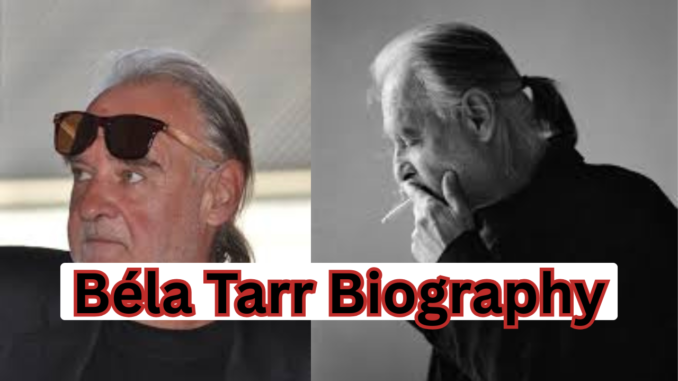
Biography
Béla Tarr was one of the most important and influential filmmakers in modern European cinema. He was born on July 21, 1955, in Pécs, Hungary, and grew up in Budapest. From a very young age, Tarr was surrounded by art, performance, and storytelling. His parents both worked in the theatre and film world. His father, also named Béla Tarr, was a set designer, while his mother, Mari Tarr, worked for more than fifty years as a theatre prompter. This artistic environment shaped his thinking and helped him develop a deep interest in human behavior, time, and realism.
Advertisements
As a child, Tarr was exposed to both literature and cinema. At the age of ten, he appeared in a television adaptation of Leo Tolstoy’s The Death of Ivan Ilyich, after his mother took him to a casting session. Although he never seriously pursued acting, this early experience gave him confidence around cameras and storytelling. When he turned fourteen, his father gave him an 8mm camera. This moment changed his life. Instead of seeing film as entertainment, Tarr began to see it as a way to observe reality.
As a teenager, he formed a small filmmaking group with friends called Dziga Vertov, named after the famous Soviet filmmaker. Their amateur film Guest Workers won first prize at a local film festival. However, this success also brought him attention from communist authorities, who questioned him because of the film’s social themes. Tarr later applied to study philosophy at university, but he was rejected from all higher education institutions in Hungary at the time. As a result, he took on different jobs and focused fully on filmmaking.
From the beginning, Béla Tarr believed cinema should show life honestly, without decoration or false hope. His biography is the story of a man who turned rejection and hardship into a unique artistic voice that later influenced filmmakers around the world.
Career
Béla Tarr began his professional career in the 1970s, first working on documentary-style projects. His early films focused on poor and working-class people living difficult lives in urban Hungary. These early works reflected strong social realism and were influenced by real locations and non-professional actors. This style became known as “social cinema,” and Tarr later described it as his attempt to tell the truth about everyday life.
His first feature film, Family Nest (1979), was made with a very small budget and shot in just a few days. Despite its simplicity, the film received strong attention for its raw realism. It showed a young couple struggling to survive while living with relatives in a cramped apartment. This theme of human struggle would remain central throughout Tarr’s career.
In the early 1980s, Tarr continued this style with films like The Outsider and The Prefab People. However, his artistic direction changed significantly after his television adaptation of Macbeth in 1982. This project used only two long shots, signaling his move toward long takes and slow pacing.
A major turning point came when Tarr began working with Hungarian writer László Krasznahorkai. Together, they created Damnation (1988), a dark and atmospheric film that introduced the visual style Tarr would become famous for. This collaboration reached its peak with Sátántangó (1994), a seven-hour black-and-white film made up of long, slow shots. Although challenging for many viewers, the film is now considered one of the greatest films ever made and a cornerstone of “slow cinema.”
Later films such as Werckmeister Harmonies (2000) and The Man from London (2007) continued to explore despair, chaos, and human isolation. His final feature film, The Turin Horse (2011), was widely praised and marked the end of his career as a feature film director. After its release, Tarr announced his retirement, saying he had said everything he wanted to say through cinema.
Even after retirement, Tarr remained active in the arts. He founded an international film school called film.factory in Sarajevo, where he mentored young filmmakers from around the world. He also created large-scale installations and performance-based projects, proving that his creativity extended far beyond traditional filmmaking.
Personal Life
Béla Tarr was a deeply private person who preferred to express himself through art rather than public appearances. His personal life was closely tied to his work. For many years, he lived between Budapest and Sarajevo, especially after founding his film school. He believed in collective creation and often spoke against commercial cinema and profit-driven filmmaking.
Tarr’s worldview was shaped by philosophy, literature, and lived experience. He often said that he did not believe in traditional storytelling or happy endings. His films reflected his belief that life is repetitive, slow, and often cruel. These ideas were not just artistic choices but reflections of his personal understanding of the world.
He avoided social media and celebrity culture and focused instead on teaching, writing, and supporting human rights causes. In 2011, he publicly defended imprisoned filmmakers, showing his strong belief in artistic freedom and justice.
Despite his serious public image, those close to him described him as warm, loyal, and deeply committed to his collaborators and students.
Family
Béla Tarr was born into a creative family. His father worked as a set designer, and his mother dedicated her life to theatre. His brother, György Tarr, became a painter, continuing the family’s artistic tradition. Art was not a profession in the Tarr household; it was a way of life.
In his adult life, Tarr’s closest personal and professional relationship was with Ágnes Hranitzky. She was his life partner and creative partner for many years, working as a film editor and later as a co-director. Their collaboration played a major role in shaping the rhythm and structure of his films.
Tarr did not publicly focus on marriage or children, choosing instead to build a family through long-term artistic collaboration. He often described his crew and students as part of his extended family. His relationships with writers, composers, actors, and cinematographers were based on trust and shared vision.
Cause of Death
Béla Tarr passed away on January 6, 2026, in Budapest, Hungary. He was 70 years old. His death came after a long and serious illness. While specific medical details were not widely shared, it was known that his health had been declining in his final years.
News of his death spread quickly through the international film community. Filmmakers, critics, and students paid tribute to his influence and his uncompromising artistic vision. His passing marked the end of an era in world cinema, but his films continue to inspire new generations.
Conclusion
Béla Tarr was more than a filmmaker. He was a philosopher of cinema who challenged audiences to slow down, observe, and reflect on the human condition. His films rejected easy answers and forced viewers to confront silence, suffering, and time itself. Through a career built on honesty and artistic courage, Tarr reshaped modern cinema. His legacy lives on in his films, his students, and the many artists he inspired around the world.
FAQs
Who was Béla Tarr?
Béla Tarr was a Hungarian filmmaker known for long takes, black-and-white films, and deep philosophical themes.
What is Béla Tarr’s most famous film?
His most famous film is Sátántangó (1994), which is considered a masterpiece of slow cinema.
Was Béla Tarr married?
He was not publicly known for marriage but had a long-term life and work partnership with editor and director Ágnes Hranitzky.
How did Béla Tarr die?
Béla Tarr died after a long and serious illness on January 6, 2026, in Budapest.
Why did Béla Tarr retire from filmmaking?
After The Turin Horse (2011), he said he had fully expressed his artistic vision and chose to focus on teaching and alternative art forms.

Peter Charles is a journalist and writer who covers battery-material recycling, urban mining, and the growing use of microreactors in industry. With 10 years of experience in industrial reporting, he explains new technologies and industry changes in clear, simple terms. He holds both a BSc and an MSc in Electrical Engineering, which gives him the technical knowledge to report accurately and insightfully on these topics.