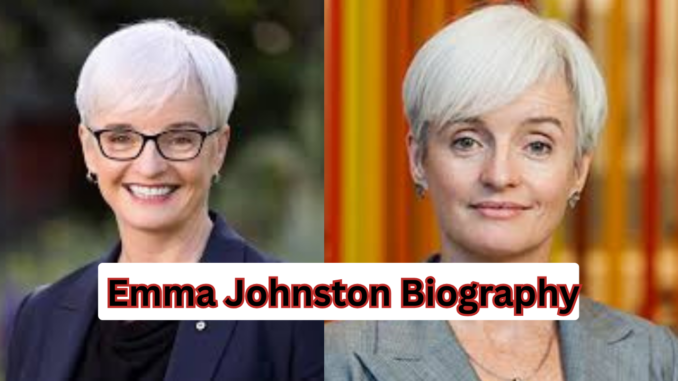
Biography
Emma Letitia Johnston was born in 1973 and grew up in Williamstown, a coastal suburb of Melbourne, Australia. Living close to the sea shaped her worldview early. As a child, she spent countless hours swimming, snorkelling, and sailing. The ocean wasn’t just a playground for her; it was a classroom without walls.
Advertisements
Interestingly, Emma did not grow up planning to become a biologist. In high school, she focused on physics and chemistry, not biology. But life has a funny way of nudging people toward their true calling. When she began her undergraduate studies at the University of Melbourne, she made a bold decision to switch her focus to biology. That choice would define the rest of her life.
She completed her Bachelor of Science degree in 1998, graduating with first-class honours. Her academic brilliance was obvious early on, but Emma was never just about grades. In 1994, she was elected President of the Melbourne University Student Union for 1995, leading what was then the largest student organization in Australia. That role showed her early talent for leadership and advocacy.
Emma went on to complete her PhD in marine ecology in 2002, also at the University of Melbourne. Her doctoral research focused on the effects of copper pollution on marine ecosystems, a topic that would later influence much of her groundbreaking research.
By the time she earned her doctorate, it was clear: Emma Johnston wasn’t just entering science. She was ready to reshape it.
Career
Emma Johnston’s career was nothing short of extraordinary. She joined the University of New South Wales (UNSW Sydney) in 2001 as an associate lecturer. From there, her rise was steady, earned, and deeply impactful.
At UNSW, she became the Head of the Applied Marine and Estuarine Ecology Lab, leading a research group that examined how human activity affects marine environments. Her work combined ecology, microbiology, and ecotoxicology, helping scientists understand not just what was happening underwater, but why it was happening.
Emma led major research projects funded by:
- The Australian Research Council
- Government agencies
- Industry partners
- The Australian Antarctic Science Program
Her research took her far beyond lecture halls. She worked in Sydney Harbour, Antarctica, the Great Barrier Reef, and temperate Australian estuaries. One of her most important discoveries showed that toxic contaminants can actually help invasive species thrive, a finding that changed how scientists and policymakers think about pollution and biodiversity.
She later became the inaugural Director of the Sydney Harbour Research Program, a flagship project that brought together scientists, policymakers, and the public to better understand one of Australia’s most iconic waterways.
Emma’s leadership roles continued to expand:
- Dean of Science at UNSW
- Pro-Vice-Chancellor for Research at UNSW
- Deputy Vice-Chancellor (Research) at the University of Sydney
In February 2025, she reached one of the highest positions in Australian academia when she was appointed Vice-Chancellor of the University of Melbourne. It was a historic and fitting achievement for someone who had dedicated her life to education and research.
Alongside her academic work, Emma was also President of Science & Technology Australia, where she advocated strongly for science funding and greater participation of women in research.
Personal Life
Emma Johnston was deeply passionate about science, but she was also human, grounded, and relatable. She often spoke about how growing up near the sea shaped her identity. The ocean was not just her research subject; it was part of who she was.
She was known for her ability to explain complex scientific ideas in simple, engaging ways. Whether on ABC TV’s Catalyst or as a co-presenter of the Foxtel/BBC series Coast Australia, Emma had a rare gift: she could make science feel personal.
To her, science wasn’t locked in laboratories. It was alive, moving, and relevant to everyday life. That belief led her to launch “Underwater Secrets – Sydney Harbour Revealed,” a public science cruise designed to help everyday people understand marine research firsthand.
Emma was also known as a mentor. She supported early-career researchers, especially women, and consistently used her platform to push for fairness, inclusion, and evidence-based decision-making.
While she kept much of her private life away from the spotlight, colleagues and students often described her as warm, determined, and deeply committed to making the world better through knowledge.
Family
Emma Johnston came from a highly educated and intellectually rich family.
Her father was an applied mathematician who held a PhD in chemical engineering from Manchester University. Her mother was a painter with a master’s degree in chemistry from Leeds University. Growing up in a household where science and creativity coexisted clearly influenced Emma’s ability to think across disciplines.
Although Emma did not publicly share extensive details about her own spouse or children, it is clear that her family background played a key role in shaping her curiosity, discipline, and love for learning.
Her family also supported her throughout her illness, and her death was confirmed to have occurred in Melbourne.
Cause of Death
Emma Johnston passed away on 26 December 2025 in Melbourne, Australia.
According to confirmed reports, she died due to complications associated with cancer. Her death came less than a year after she began her role as Vice-Chancellor of the University of Melbourne, making the loss especially heartbreaking for the academic and scientific community.
Despite her illness, Emma continued to lead, inspire, and advocate for science for as long as she could. Her passing was widely mourned across universities, research institutions, and public science organizations.
Legacy and Impact
Emma Johnston’s legacy is not just found in her 185 peer-reviewed publications or her impressive h-index of 62. It lives in the policies she influenced, the students she mentored, the ecosystems she helped protect, and the way she made science accessible to the public.
She received numerous honors, including:
- Officer of the Order of Australia (AO)
- Nancy Millis Medal for Women in Science
- Clarke Medal
- NSW Scientist of the Year
- Fellowships from leading Australian scientific academies
Emma proved that scientists can be leaders, communicators, and changemakers all at once.
Conclusion
Emma Johnston’s life was like the ocean she loved—deep, powerful, and full of purpose. From a curious child swimming in Melbourne’s coastal waters to a national leader in science and higher education, she lived with intention and impact.
Her story reminds us that science is not just about data and discoveries. It’s about people, responsibility, and the future we choose to build. Emma Johnston may be gone, but her work, her voice, and her influence will continue to shape Australian science for generations to come.
FAQs
Who was Emma Johnston?
Emma Johnston was an Australian marine ecologist, academic leader, and science communicator who served as Vice-Chancellor of the University of Melbourne in 2025.
What was Emma Johnston known for?
She was known for her research on marine ecosystems, science advocacy, leadership in higher education, and public science communication.
What caused Emma Johnston’s death?
She died in December 2025 due to complications related to cancer.
What awards did Emma Johnston receive?
She received many awards, including the Nancy Millis Medal for Women in Science, the Clarke Medal, and was appointed an Officer of the Order of Australia.
Why is Emma Johnston important to Australian science?
She played a major role in marine ecology research, science policy, public engagement, and advancing women’s participation in science.

Peter Charles is a journalist and writer who covers battery-material recycling, urban mining, and the growing use of microreactors in industry. With 10 years of experience in industrial reporting, he explains new technologies and industry changes in clear, simple terms. He holds both a BSc and an MSc in Electrical Engineering, which gives him the technical knowledge to report accurately and insightfully on these topics.