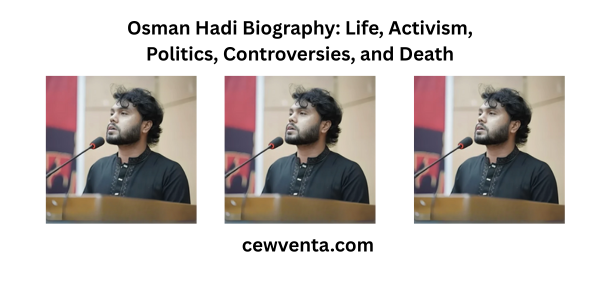
Biography
Sharif Osman Bin Hadi, widely known as Osman Hadi, was born on 30 June 1993 in Nalchity Upazila, Jhalokathi District, Bangladesh. He grew up in a religious Muslim household, shaped strongly by faith, discipline, and community values. His father was a madrasa teacher and a local imam, and this background deeply influenced Osman Hadi’s moral outlook, public speaking style, and sense of responsibility toward society. He was the youngest among six siblings and was raised in an environment where education, ethics, and social justice were highly valued.
From an early age, Osman Hadi showed strong interest in public affairs, debate, and social issues. Growing up in rural Bangladesh, he witnessed poverty, political inequality, and the effects of power imbalance on ordinary citizens. These early experiences planted the seeds of his later activism. His upbringing combined religious education with awareness of national identity, which later shaped his political positions, especially his views on sovereignty and foreign influence.
He completed his secondary and higher secondary education at Jhalakati N.S. Kamil Madrasa, where he passed the Alim examination, an Islamic equivalent of higher secondary education. His academic strength and interest in politics led him to enroll at the University of Dhaka, where he studied Political Science during the 2010–2011 academic session. The University of Dhaka, long known as the heart of political thought and activism in Bangladesh, played a major role in shaping his political ideology and leadership skills.
Osman Hadi later became a well-known youth activist and political organizer. He rose to national attention after the July Revolution, where his outspoken criticism of state repression, political corruption, and foreign dominance resonated with many young people. Until his death on 18 December 2025, Osman Hadi remained one of the most visible and controversial young political figures in Bangladesh.
Career
Osman Hadi’s career was a unique mix of education, activism, and politics. Before entering full-time political organizing, he worked as an English language coach at Saifur’s Coaching Center, one of the most popular private education institutions in Bangladesh. This role helped him develop strong communication skills and confidence in public speaking, which later became central to his activism.
He later joined the University of Scholars, a private university in Dhaka, as a lecturer. Teaching allowed him to engage with young minds and sharpen his political and social arguments. His time as an educator strengthened his belief that political awareness and civic responsibility must begin with youth education.
Osman Hadi became nationally prominent during the July Revolution, a period of mass protests and youth-led movements demanding accountability for killings, repression, and corruption. At the time, he lived in Rampura, Dhaka, where he served as a local coordinator, organizing protests, meetings, and political discussions. His ability to mobilize young people and articulate strong political messages brought him into the national spotlight.
He was one of the founders and leaders of Inqilab Moncho, a political platform born from the July uprising. Inqilab Moncho presented itself as a movement-based organization rather than a traditional political party. Its goals included defending Bangladesh’s independence, opposing all forms of domination, and building what Osman Hadi described as an “Insaaf-based state”, meaning a state rooted in justice and fairness.
Osman Hadi was especially vocal about banning the Awami League from politics, accusing the party of repression, corruption, and responsibility for protest-related deaths. At public gatherings, including a large “martyrs’ assembly” in Shahbagh, he urged opposition parties to include the trial and banning of the Awami League in their election promises. He also announced plans for mass marches and long-term protests if demands were not met.
In May 2025, he called for the formation of a National Government that would include all anti–Awami League forces, such as the Bangladesh Nationalist Party, Jamaat-e-Islami, and other opposition groups. He believed that unity among opposition forces was necessary to prevent what he called the return of authoritarian politics.
Ahead of the 2026 general election, Osman Hadi announced his intention to contest as an independent candidate for the Dhaka-8 constituency. He organized consultation meetings, conducted a “van rally,” and promised to expose corruption if elected. His campaign language was aggressive, direct, and appealing to frustrated young voters who felt ignored by traditional politicians.
Personal Life
Despite his public presence, Osman Hadi kept his personal life largely private. He did not frequently speak about his family in public, choosing instead to focus on political issues and national debates. However, it was known that he remained close to his family and deeply respected his parents, especially his father’s role as a religious teacher.
Osman Hadi lived a modest lifestyle. Friends and supporters often described him as disciplined, focused, and deeply committed to his beliefs. He spent most of his time organizing meetings, writing, speaking, or engaging with supporters both online and offline. Social media played a major role in his activism, as he used it to share statements, criticize political developments, and mobilize supporters.
He was also an author. In February 2024, he published a Bengali book titled “লাভায় লালশাক পূবের আকাশ” (The Eastern Sky Turned Red Amaranth by Lava). The book reflected his revolutionary ideas, emotional intensity, and vision of political change. Writing was another way through which he expressed his frustration, hope, and political philosophy.
Controversies
Osman Hadi was no stranger to controversy. His sharp language, uncompromising positions, and frequent criticism of both ruling and opposition parties made him a polarizing figure. He openly accused several opposition groups of trying to monopolize the July uprising and claimed that some youth leaders had become corrupt after gaining influence.
One major controversy occurred during the National Citizen Party’s March to Gopalganj, where clashes broke out. In a moment of anger, Osman Hadi used profanity and made comments calling for the dissolution of Gopalganj District. The statement caused widespread outrage and debate across the country. Critics accused him of irresponsibility and inflammatory rhetoric.
Later, Osman Hadi responded to the backlash by calling his statement an “epic of liberation”, though he also expressed regret to those who felt offended. This incident highlighted both his emotional political style and the risks of extreme rhetoric in a tense political environment.
He also faced criticism for his strong anti-Indian stance, which some viewed as necessary nationalism and others saw as dangerous escalation. Despite criticism, Osman Hadi refused to soften his positions, insisting that fear and compromise were the reasons past movements had failed.
Cause of Death
On 12 December 2025, Osman Hadi was shot in the head at approximately 2:25 p.m. in the Paltan area of Dhaka, shortly after leaving a mosque following Jumma prayers. According to police reports, the attack was carried out by assailants on a motorcycle. The shooter was identified as Faisal Karim Masud, with Alamgir Sheikh allegedly driving the motorcycle. Another individual, Rubel, was accused of surveilling Hadi before the attack.
Osman Hadi was rushed to Dhaka Medical College Hospital, where he was found to be in a deep coma with a Glasgow Coma Scale score of 3, indicating critical brain injury. He was later transferred to Evercare Hospital Dhaka, and on 15 December, the government airlifted him to Singapore General Hospital for advanced treatment.
Despite all medical efforts, Osman Hadi died on 18 December 2025 at around 9:30 p.m. from complications related to his gunshot injuries.
His death triggered widespread unrest across Bangladesh, especially in Dhaka. Protests turned violent, media offices were attacked, and strong anti-Indian sentiment surfaced. The government announced a BDT 5 million reward for information related to the attackers. His killing became one of the most politically significant assassinations in recent Bangladeshi history.
Conclusion
Osman Hadi’s life was short but deeply impactful. From a madrasa-educated youth in Jhalokathi to a national political figure, his journey reflected the anger, hope, and restlessness of a generation seeking change. He challenged powerful institutions, inspired young activists, and paid the ultimate price for his political stance. Whether remembered as a revolutionary hero or a controversial agitator, Osman Hadi’s legacy will continue to shape political conversations in Bangladesh for years to come.
Frequently Asked Questions (FAQs)
Who was Osman Hadi?
Osman Hadi was a Bangladeshi politician, activist, and founder of Inqilab Moncho, known for his role in the July Revolution and youth-led movements.
What was Osman Hadi known for?
He was known for opposing Indian influence, demanding justice for July martyrs, and calling for a ban on the Awami League.
How did Osman Hadi die?
He died on 18 December 2025 from gunshot injuries after being attacked in Dhaka on 12 December.
Was Osman Hadi involved in elections?
Yes, he announced his candidacy as an independent candidate for the Dhaka-8 constituency ahead of the 2026 general election.
Why was Osman Hadi controversial?
His strong language, radical demands, criticism of political parties, and anti-Indian rhetoric made him a highly controversial figure.
Leave a Reply