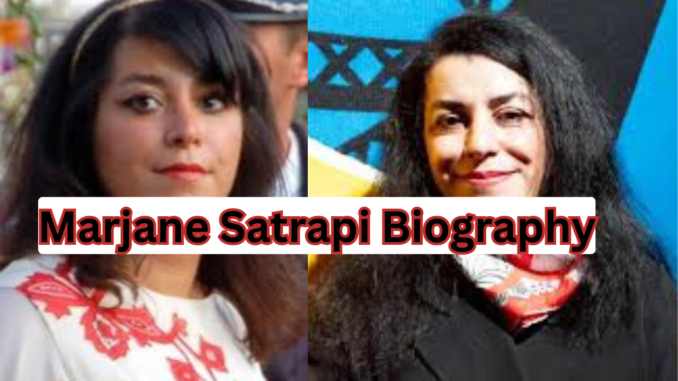
Biography
Marjane Satrapi was born as Marjane Ebrahimi on November 22, 1969, in Rasht. Shortly after her birth, her family moved to Tehran, where she spent most of her childhood. She grew up in an educated upper-middle-class family that strongly believed in politics, education, and social justice. Her parents actively opposed political oppression and encouraged independent thinking from a young age.
Advertisements
Her childhood coincided with one of the most dramatic periods in modern Iranian history. The 1979 revolution changed everyday life across the country, and young Marjane witnessed political arrests, executions, protests, censorship, and war during her early years. These experiences would later become central themes in her writing and artwork.
Satrapi often spoke openly about how violence, fear, and uncertainty shaped her personality. Many people close to her family disappeared, faced imprisonment, or suffered persecution. One of the most important figures in her life was her uncle Anoosh, who became a political prisoner and later died after being executed. These deeply personal experiences influenced the emotional power of her later work.
Education and Moving Abroad
As political restrictions increased, Satrapi’s parents worried about her future and safety. At age fourteen, they sent her to study in Austria. Moving abroad proved extremely difficult.
Living alone during her teenage years, she experienced loneliness, financial problems, homelessness, and severe illness. She later described this period as emotionally painful but important in shaping her understanding of identity and belonging. Eventually, she returned to Iran before later moving permanently to France to continue studying art.
This movement between cultures became one of the defining themes throughout her life and artistic career.
Career
Marjane Satrapi achieved worldwide recognition because of Persepolis, her autobiographical comic series first published between 2000 and 2003. The book told the story of her childhood during the Iranian Revolution and her later experiences living in Europe. The work quickly became internationally successful because it combined political history with personal storytelling.
Unlike traditional memoirs, Persepolis used black-and-white illustrations to communicate complex emotions and historical events. Readers across different cultures connected with the story because it explored universal themes such as family, identity, migration, loss, and growing up.
The success of Persepolis transformed Satrapi into one of the most widely read Iranian writers in the world. The graphic memoir remains one of the most influential works ever published in comic form. Community readers frequently describe the book as both heartbreaking and deeply relatable because it combines humor with political trauma.
After Persepolis, she published other successful works including: Chicken with Plums, Embroideries and Woman, Life, Freedom
These works further established her reputation as a powerful storyteller.
Success as a Filmmaker
Satrapi successfully moved from comics into filmmaking. She co-directed the animated adaptation of Persepolis, which premiered at the Cannes Film Festival and won major recognition. The film later received an Academy Award nomination, making Satrapi the first woman ever nominated for Best Animated Feature. (Wikipedia)
Her directing career continued with projects including: Chicken with Plums, The Voices, Radioactive and Dear Paris
These films showed her ability to work across animation, comedy, biography, and dark drama.
Satrapi became more than an artist. She became an outspoken activist.
She strongly supported women’s rights movements and frequently criticized political repression in Iran. Following the protests after the death of Mahsa Amini, Satrapi publicly supported the Woman, Life, Freedom movement and created projects designed to explain the protests to international audiences.
In 2025, she rejected France’s highest honor because she disagreed with French policies toward Iranian dissidents. Her decision generated major international discussion.
Personal Life
Marriage and Relationships
Marjane Satrapi married for the first time when she was young. Her first marriage to Reza eventually ended in divorce.
Later, she married Mattias Ripa, a Swedish actor and producer who became one of the most important people in her life. Their relationship lasted for decades and remained central to her personal happiness.
Friends frequently described the couple as deeply connected both personally and professionally.
Satrapi lived primarily in Paris and spoke multiple languages, including Persian, French, English, German, Swedish, and Italian. Her multicultural lifestyle strongly influenced her worldview and artistic voice.
Despite international fame, she maintained a reputation for speaking openly and refusing to change her opinions for popularity.
Family
Family played an enormous role in Satrapi’s life and writing.
Her parents strongly encouraged education, independence, and political awareness. They supported her decision to move abroad despite the emotional difficulty of separation. Much of her family history became part of her storytelling.
Satrapi frequently discussed her uncle Anoosh, whose imprisonment and execution deeply affected her worldview. She also often credited the strong women in her family for shaping her personality and feminist beliefs. (Wikipedia)
Although she did not have children, Satrapi repeatedly argued that fulfillment does not depend on motherhood and emphasized personal freedom and independence.
Age
Marjane Satrapi was born on November 22, 1969.
She died in June 2026 at the age of 56. Her relatively young age made her death especially shocking because she remained active creatively until shortly before her passing.
Cause of Death
Marjane Satrapi died in Paris in June 2026 at age 56. Family members stated publicly that she had “died of sadness” after struggling with grief following the death of her husband, Mattias Ripa, who died in 2025.
No detailed medical explanation was immediately released publicly.
The announcement triggered emotional responses worldwide. Writers, filmmakers, activists, and political leaders paid tribute to her influence and contributions. French officials, artists, and authors praised her courage, creativity, and willingness to challenge injustice through storytelling.
Her passing marked the end of one of the most important creative voices connecting Middle Eastern experiences with global audiences.
Conclusion
Marjane Satrapi’s life cannot simply be described as the story of an author or filmmaker. She transformed painful personal experiences into art that educated millions of people around the world.
Through Persepolis and many other works, she showed readers what revolution, exile, family, identity, and resistance truly feel like from a human perspective. Her art crossed political borders and cultural divisions.
Although her life ended at 56, her influence continues through books, films, activism, and the countless readers who discovered their own stories inside hers.
Her legacy remains one of courage, honesty, and creative freedom.
FAQs
Who is Marjane Satrapi famous for being?
Marjane Satrapi became famous mainly because of Persepolis, the autobiographical graphic novel about growing up during the Iranian Revolution.
How old was Marjane Satrapi when she died?
She died at age 56 in June 2026.
What was Marjane Satrapi’s cause of death?
Her family stated she died from sadness and grief following the death of her husband, although detailed medical information was not publicly released.
Was Marjane Satrapi married?
Yes. She was married twice and remained married to Mattias Ripa until his death in 2025.
What movies did Marjane Satrapi direct?
Her directing work includes Persepolis, The Voices, Radioactive, and Chicken with Plums.

Peter Charles is a journalist and writer who covers battery-material recycling, urban mining, and the growing use of microreactors in industry. With 10 years of experience in industrial reporting, he explains new technologies and industry changes in clear, simple terms. He holds both a BSc and an MSc in Electrical Engineering, which gives him the technical knowledge to report accurately and insightfully on these topics.